THE MET
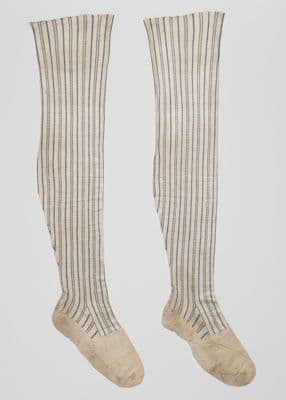
Cream Ribbed Silk Cotton Knee-High Stockings
Neoclassical Transition · 1780s · British
Production
handmade
Material
silk and cotton
Culture
British
A pair of knee-high stockings featuring vertical ribbed construction in cream-colored silk and cotton blend. The ribbing creates narrow vertical channels that run the full length of each stocking, providing both decorative texture and functional stretch. The stockings have reinforced heel and toe areas in a natural tan or light brown color, showing the practical construction typical of 18th-century hosiery. The ribbed knit structure would have provided a snug fit around the leg while allowing for movement. These stockings represent the refined everyday legwear worn by middle and upper-class women during the late Georgian period, when such hosiery was a mark of gentility and proper dress.
tights/stockingstight fit
Connected To
Worn with·chemiseWorn with·gownWorn with·petticoatWorn with·stays
SHARED80 years · cross-culture · cross-category
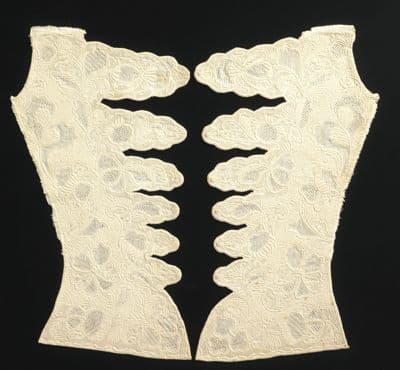
These cream-colored undergarments speak to the enduring obsession with refining what lies beneath the surface of dress. The stockings' precise vertical ribbing and the bodice fronts' intricate whitework embroidery both transform functional undergarments into objects of quiet luxury—one through rhythmic texture, the other through painstaking needlework that creates its own topography of raised threads and negative space.
Text65%
67%
Worn with·chemiseWorn with·gownWorn with·staysTechnique·knitting
Worn with·chemiseWorn with·gownWorn with·stays
SHARED20 years · cross-culture · cross-category
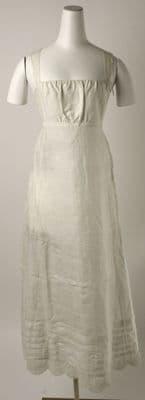
These pieces share the understated elegance of neoclassical restraint—the petticoat's clean empire line and the stockings' precise vertical ribbing both reject the baroque excess that came before. The linen's crisp simplicity and the stockings' disciplined stripes speak the same visual language of refined geometry, where ornamentation comes from perfect proportions rather than applied decoration.
Worn with·chemiseWorn with·gownWorn with·stays
SHARED20 years · cross-culture · cross-category
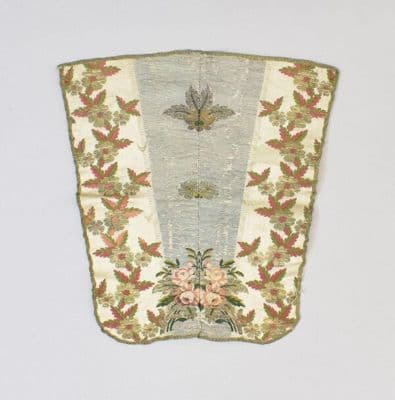
These cream silk pieces reveal how 18th-century English dressing balanced restraint with subtle luxury across every layer of the body. The stockings' delicate vertical ribs create the same kind of refined texture as the stomacher's woven florals—both using silk's natural luster to catch light without shouting about it. Twenty years and several garment categories apart, they share that particularly English genius for making understatement feel like the most sophisticated choice in the room.
Echoes Across Time
Neoclassical Transition → Baroque · 80yr69%
SHARED
These cream-colored undergarments speak to the enduring obsession with refining what lies beneath the surface of dress. The stockings' precise vertical ribbing and the bodice fronts' intricate whitework embroidery both transform functional undergarments into objects of quiet luxury—one through rhythmic texture, the other through painstaking needlework that creates its own topography of raised threads and negative space.
Worn with·chemiseWorn with·gownWorn with·petticoat
Pull the Thread→
Follow this garment wherever the graph leads