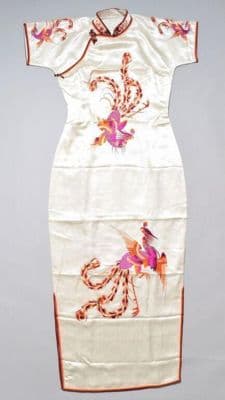
Wartime / Utility Fashion · 1940s · Chinese
Production
handmade
Material
silk satin
Culture
Chinese
Influences
traditional Chinese qipao · Western tailoring techniques
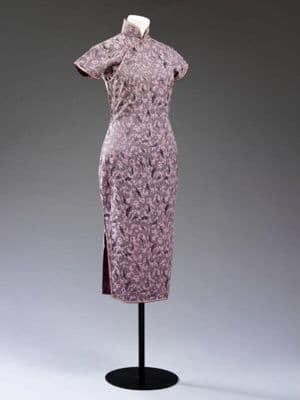
This qipao features a fitted silhouette with a high mandarin collar and asymmetrical front closure secured by fabric-covered buttons. The dress is constructed from ivory silk satin with hand-embroidered floral motifs in coral, magenta, and burgundy threads. The embroidery depicts stylized flowering branches and birds, concentrated on the upper bodice and lower skirt panels. The garment has short sleeves with contrasting burgundy piping that continues along the collar and front closure. The straight-cut skirt extends to mid-calf length with side slits for ease of movement. This represents the modernized qipao style popular in post-war China and Hong Kong, blending traditional Chinese dress elements with contemporary tailoring techniques.
These two qipao reveal how Chinese dress codes traveled and transformed through wartime disruption. The earlier white silk piece, with its hand-embroidered phoenixes and chrysanthemums, carries the formal vocabulary of pre-war Shanghai tailoring—notice how the embroidery flows asymmetrically across the body, creating movement within the rigid silhouette.
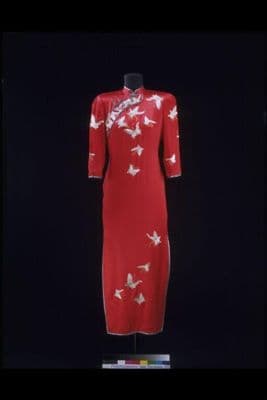
Both qipaos speak the same visual language of scattered florals against silk, but they're having entirely different conversations. The red dress whispers its white butterflies across the surface like secrets, while the cream one shouts its pink and coral blooms in bold, almost defiant clusters that climb from hem to shoulder.


Follow this garment wherever the graph leads
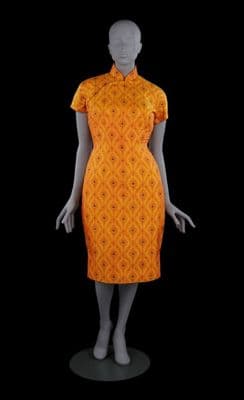
These two qipao dresses trace the evolution of Chinese formal wear through turbulent decades, from wartime austerity to postwar prosperity. The earlier white silk dress, with its delicate floral embroidery and restrained palette, reflects the refined simplicity demanded by wartime rationing—beauty achieved through skilled handwork rather than costly materials.
Both qipaos speak the same visual language of scattered florals against silk, but they're having entirely different conversations. The red dress whispers its white butterflies across the surface like secrets, while the cream one shouts its pink and coral blooms in bold, almost defiant clusters that climb from hem to shoulder.
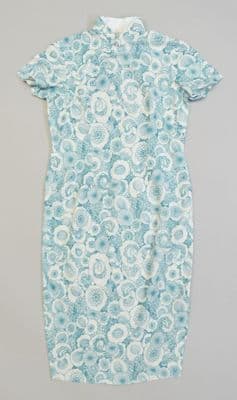
These two qipao dresses reveal how a silhouette travels through time and circumstance, adapting its language but keeping its essential grammar intact. The earlier white silk version speaks in the formal dialect of hand-embroidered phoenixes and meticulous piping—luxury made practical during wartime rationing—while the 1970s Hong Kong jersey dress translates that same body-conscious fit and stand collar into the casual vernacular of synthetic fabrics and machine-printed florals.
These two pieces trace the qipao's journey from necessity to nostalgia, separated by decades but united by that distinctive Mandarin collar and body-skimming silhouette. The white silk satin dress, likely from the 1940s, shows the qipao in its utilitarian prime—clean lines, minimal embroidery, the kind of restrained elegance that defined Chinese women's dress during wartime.