Traditional Chinese · 1980s · Taiwanese
Production
handmade
Material
silk satin
Culture
Taiwanese
Influences
traditional Chinese qipao · Manchu banner dress origins
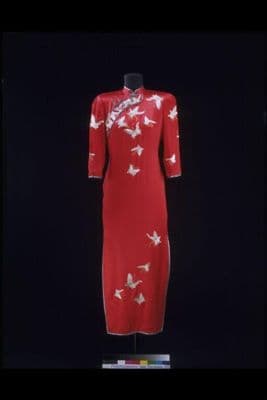
A traditional Chinese qipao rendered in vibrant red silk satin with white embroidered butterfly motifs scattered across the surface. The dress features the characteristic high mandarin collar, fitted bodice that follows the natural waistline, and straight narrow skirt extending to ankle length. Three-quarter length sleeves maintain the garment's modest coverage while the side seams likely contain the traditional pankou button closures, though not visible from this front view. The embroidered butterflies appear to be executed in white silk thread using satin stitch technique, creating dimensional surface decoration that catches light against the lustrous red ground fabric. This represents the qipao's evolution in 1980s Taiwan, maintaining traditional silhouette while incorporating decorative elements that bridge cultural heritage with contemporary formal wear expectations.


Both qipaos speak the same visual language of scattered florals against silk, but they're having entirely different conversations. The red dress whispers its white butterflies across the surface like secrets, while the cream one shouts its pink and coral blooms in bold, almost defiant clusters that climb from hem to shoulder.


Follow this garment wherever the graph leads
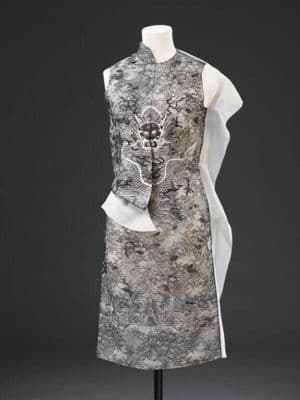
The red qipao's scattered white butterflies and the gray-on-gray dragon coiling across the later dress reveal how the cheongsam's symbolic vocabulary evolved from delicate feminine codes to bold heraldic statements. Where the butterflies float like whispered secrets across crimson silk, the dragon commands the entire torso with muscular embroidered coils that transform the body into a canvas for power rather than poetry.
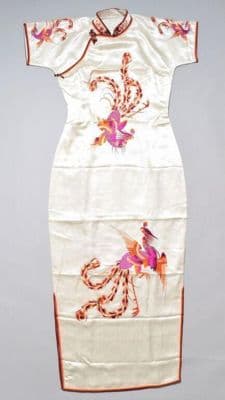
Both qipaos speak the same visual language of scattered florals against silk, but they're having entirely different conversations. The red dress whispers its white butterflies across the surface like secrets, while the cream one shouts its pink and coral blooms in bold, almost defiant clusters that climb from hem to shoulder.
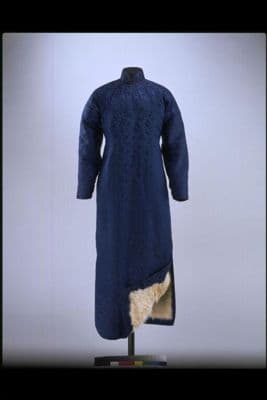
Both dresses trace their lineage to the qipao's essential grammar—that body-skimming column with its signature side closure—but they speak different dialects of desire. The red silk version floats white butterflies across its surface like scattered thoughts, while the navy damask relies on woven texture alone, its somber elegance suggesting the kind of restraint that comes from economic uncertainty.
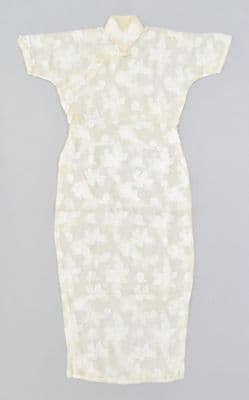
The red qipao's scattered white butterflies and the white dress's delicate floral motifs both deploy the same ancient Chinese aesthetic strategy: using nature's ephemeral beauty to animate silk's surface. Separated by decades and continents, they reveal how the qipao's essential DNA—that body-conscious silhouette with its signature side seam and mandarin collar—could absorb radically different decorative languages while maintaining its architectural integrity.
Both dresses trace their lineage to the qipao's essential grammar—that body-skimming column with its signature side closure—but they speak different dialects of desire. The red silk version floats white butterflies across its surface like scattered thoughts, while the navy damask relies on woven texture alone, its somber elegance suggesting the kind of restraint that comes from economic uncertainty.