2000s · 2010s · Chinese
Designer
Huishan Zhang
Production
haute couture
Material
silk organza
Culture
Chinese
Movement
Contemporary Chinese Fashion · Indie Sleaze
Influences
traditional Chinese qipao · dragon court robes
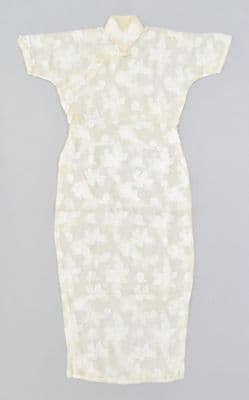
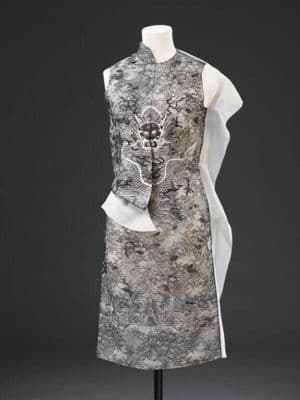
A sleeveless fitted dress with traditional Chinese qipao silhouette featuring a high mandarin collar and side closure with decorative frog buttons. The garment is constructed from silk organza with an intricate silver-grey dragon motif that appears to be embroidered or appliqued across the entire surface. The dragon design creates a tonal pattern against the light base fabric. The dress follows the body's natural lines with a straight, narrow cut that ends at knee length. The sleeveless construction emphasizes the structured collar and creates clean armhole edges. This piece represents contemporary interpretation of traditional Chinese dress forms.


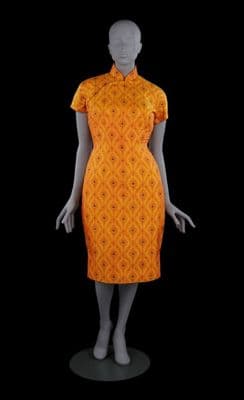
These two qipao reveal how a single silhouette can carry completely different cultural messages across decades. The 1950s Hong Kong version in golden yellow silk speaks the language of prosperity and optimism—its geometric print and body-skimming fit capturing the confident modernity of post-war Hong Kong's emerging identity.


Follow this garment wherever the graph leads
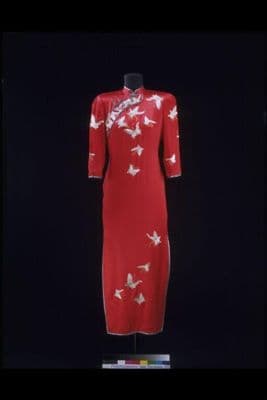
The red qipao's scattered white butterflies and the gray-on-gray dragon coiling across the later dress reveal how the cheongsam's symbolic vocabulary evolved from delicate feminine codes to bold heraldic statements. Where the butterflies float like whispered secrets across crimson silk, the dragon commands the entire torso with muscular embroidered coils that transform the body into a canvas for power rather than poetry.
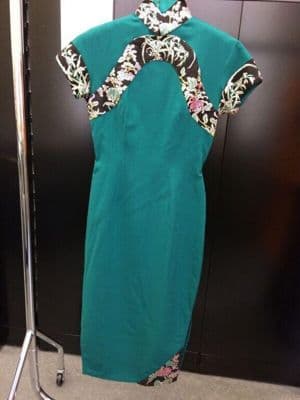
These two qipao capture the form's evolution from practical elegance to pure spectacle. The teal wool dress, with its modest length and floral-trimmed collar, represents the 1950s Hong Kong refinement of the Shanghai original—still wearable, still rooted in daily life, but already softened for a broader audience. The silvery organza piece pushes the qipao into costume territory, its dragon embroidery and museum-worthy construction speaking to heritage as performance rather than lived tradition.
These two qipao reveal how a single silhouette can carry completely different cultural messages across decades. The 1950s Hong Kong version in golden yellow silk speaks the language of prosperity and optimism—its geometric print and body-skimming fit capturing the confident modernity of post-war Hong Kong's emerging identity.
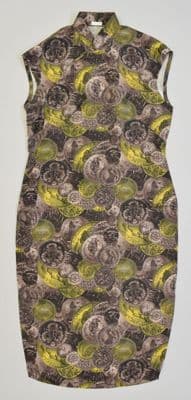
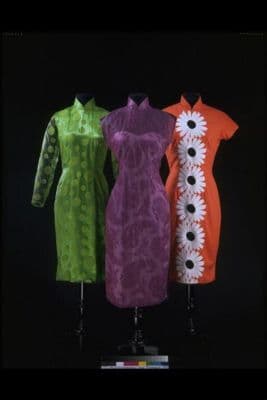
These two qipao dresses reveal how traditional Chinese silhouettes absorb and reflect their cultural moment: the 1960s version transforms ancient chrysanthemum motifs into a bold chartreuse and brown palette that could have walked off a mod runway, while the 2000s dress renders its dragon embroidery in whisper-pale silver on white organza, speaking to contemporary minimalism's preference for restraint over statement.