1950s · 1940s-1950s · Hong Kong Chinese
Production
handmade
Material
embroidered wool
Culture
Hong Kong Chinese
Movement
New Look / Post-War
Influences
traditional Chinese qipao · 1950s Western tailoring
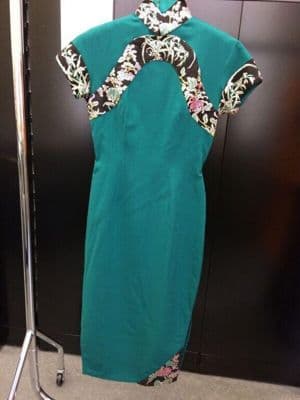
A mid-length qipao featuring a vibrant teal green wool body with contrasting white and black floral embroidered trim. The dress displays the characteristic fitted silhouette of 1950s qipao styling with a high mandarin collar, short cap sleeves, and side closure. The embroidered floral motifs create decorative bands along the collar, sleeve edges, and what appears to be the front closure placket. The garment demonstrates the evolution of traditional Chinese dress during the post-war period in Hong Kong, combining Western tailoring influences with Chinese design elements. The wool fabric suggests cooler weather wear, while the precise fit and decorative embroidery indicate formal or semi-formal occasions.
Follow this garment wherever the graph leads
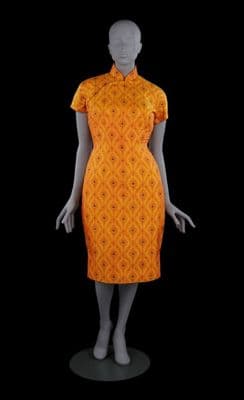
These two qipaos capture the precise moment when Shanghai tailoring met 1950s Western glamour in Hong Kong's fashion houses. The teal dress deploys embroidered florals as strategic punctuation—collar, cuffs, hem—while keeping the body clean, but the orange number commits fully to pattern, letting geometric motifs create the dress's entire visual rhythm.
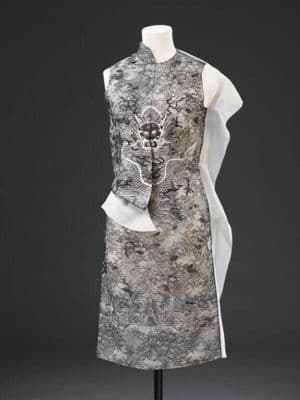
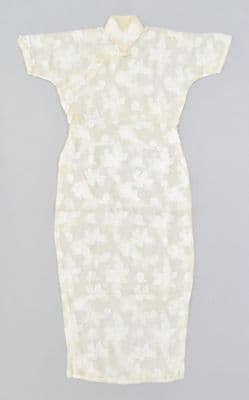
These two qipao reveal how the same silhouette can speak entirely different languages of desire. The teal wool version, with its bold floral trim snaking around the collar and sleeves, announces itself with the confidence of 1950s Hong Kong tailoring—where traditional Chinese dress met Western embellishment techniques. The white silk organza piece whispers where the other shouts, its translucent fabric and minimal construction suggesting the refined restraint of mainland Chinese couture.
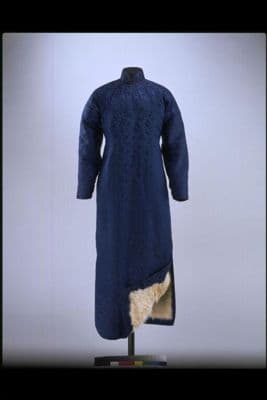
These two qipaos reveal how the same silhouette traveled through decades and social strata, adapting to circumstance while holding its essential DNA. The 1930s navy damask version speaks to pre-war prosperity with its luxurious silk and traditional high collar, while the 1950s teal wool piece shows the garment's democratic evolution—embroidered florals replacing costly damask, practical wool substituting for silk, yet maintaining that signature body-skimming fit and side closure.
These two qipao capture the form's evolution from practical elegance to pure spectacle. The teal wool dress, with its modest length and floral-trimmed collar, represents the 1950s Hong Kong refinement of the Shanghai original—still wearable, still rooted in daily life, but already softened for a broader audience. The silvery organza piece pushes the qipao into costume territory, its dragon embroidery and museum-worthy construction speaking to heritage as performance rather than lived tradition.