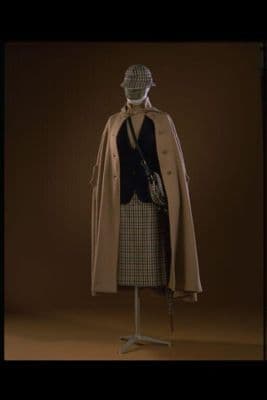
1970s · 1970s · British
Designer
Daks Simpson
Production
ready-to-wear
Material
wool
Culture
British
Movement
Hippie / Counterculture
Influences
Scottish tartan tradition · British tailoring heritage
A sophisticated British ensemble featuring a long camel-colored wool cape coat with an attached hood, worn over a black wool jacket and houndstooth check pleated skirt. The cape falls to mid-calf length with clean, unadorned lines and appears to have button closures. Underneath, a black fitted jacket is paired with a knee-length pleated skirt in a classic houndstooth pattern in black and cream. The coordinating accessories include a matching houndstooth cap and what appears to be a silk scarf. The silhouette emphasizes clean geometric lines and layered sophistication typical of late 1970s British tailoring, combining practical outerwear with refined suiting elements in a neutral palette.


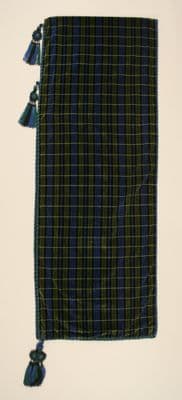
These pieces are bound by plaid's stubborn refusal to behave like other patterns — both the Victorian silk hood's crisp navy and forest grid and the 1970s ensemble's softer houndstooth check carry that distinctly Scottish DNA that makes tartan feel like armor rather than decoration.


Follow this garment wherever the graph leads
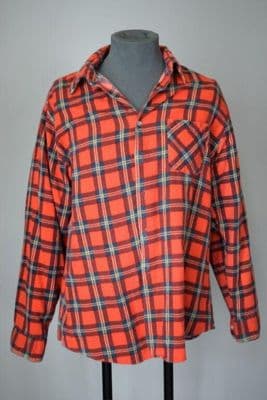
The red flannel shirt's bold tartan and that camel coat's subtle glen plaid both mine the same Scottish textile DNA, but they're speaking entirely different languages about it. The shirt shouts American counterculture rebellion—oversized, unisex, borrowed from lumberjacks and adopted by hippies who wanted to reject bourgeois dress codes.
These pieces are bound by plaid's stubborn refusal to behave like other patterns — both the Victorian silk hood's crisp navy and forest grid and the 1970s ensemble's softer houndstooth check carry that distinctly Scottish DNA that makes tartan feel like armor rather than decoration.
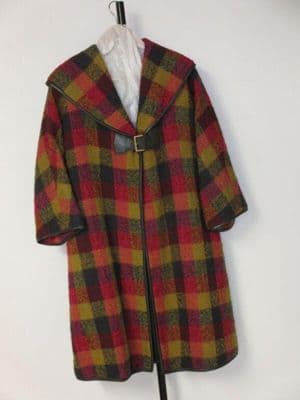
Both coats draw from Scotland's tartan legacy, but they speak different languages of plaid. The 1950s swing coat wraps its wearer in a bold, almost painterly tartan that reads as pure pattern—those burgundy and green checks scaled large enough to make a statement from across a room.
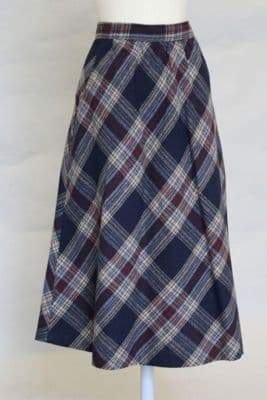
These two pieces trace the same bloodline from the Scottish Highlands to different decades of American and British wardrobes. The 1980s A-line skirt takes tartan's traditional navy-burgundy-white grid and domesticates it into safe suburban polish, while the 1970s ensemble uses the same plaid vocabulary more subversively—that houndstooth pattern on the skirt reads like tartan's intellectual cousin, paired with a dramatic camel cape that borrows the clan chief's authority.
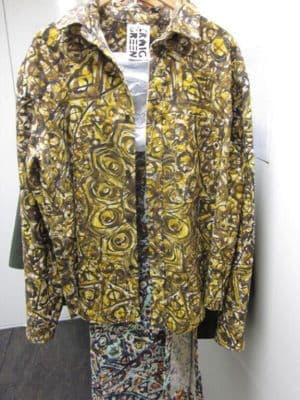
Both pieces pivot on the same radical gesture: the masculine jacket paired with a skirt, collapsing the binary with studied nonchalance. The 1970s look does it through crisp tailoring and that enveloping camel cape—very Bowie-meets-Savile Row—while the contemporary piece opts for anarchic hand-painted swirls that read like graffiti on cotton.