1980s · 1980s · American
Production
ready-to-wear
Material
wool plaid
Culture
American
Movement
Power Dressing
Influences
Scottish tartan tradition
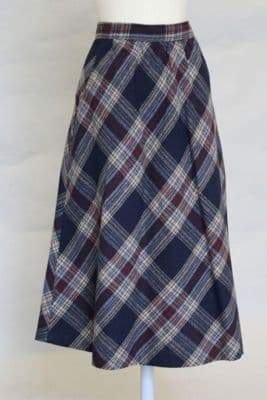
This A-line midi skirt features a classic tartan plaid pattern in navy blue, burgundy, white, and gray. The wool fabric appears to be of medium weight, creating structured drape that maintains the skirt's shape. The garment sits at the natural waist with what appears to be a fitted waistband, then flares gently to a mid-calf length. The plaid pattern runs on the bias, creating diagonal lines that enhance the skirt's movement. The construction appears to be machine-sewn with clean finishing typical of ready-to-wear garments. This style reflects the 1980s trend toward professional dressing while maintaining feminine silhouettes, representing the era's blend of traditional patterns with contemporary tailoring.
The same navy-burgundy-white tartan that wraps around this man's blazer reappears decades later in the A-line skirt's bias-cut panels, proving that certain plaid combinations have a gravitational pull that transcends both gender and time. What started as Highland clan signaling became American prep school uniform, then morphed into contemporary menswear's nostalgic nod to academic tradition—the skirt's 1980s silhouette catching the pattern at its most democratized moment.

The same navy-burgundy-white tartan that wraps around this man's blazer reappears decades later in the A-line skirt's bias-cut panels, proving that certain plaid combinations have a gravitational pull that transcends both gender and time. What started as Highland clan signaling became American prep school uniform, then morphed into contemporary menswear's nostalgic nod to academic tradition—the skirt's 1980s silhouette catching the pattern at its most democratized moment.

Follow this garment wherever the graph leads
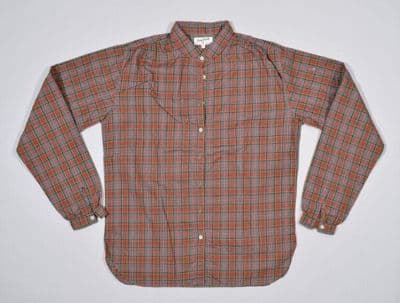
These two pieces trace the long journey of Scottish tartan from Highland clan regalia to suburban American closets. The skirt's navy-burgundy plaid runs on the bias, its diagonal stripes creating movement that feels distinctly 1980s—all shoulder pads and power lunches—while the shirt's tighter red-green check sits properly on the grain like a good British boarding school uniform.
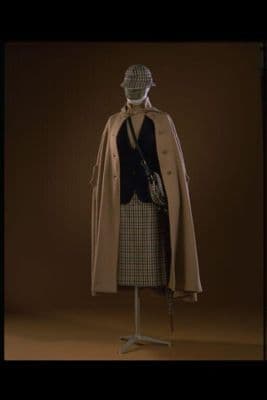
These two pieces trace the same bloodline from the Scottish Highlands to different decades of American and British wardrobes. The 1980s A-line skirt takes tartan's traditional navy-burgundy-white grid and domesticates it into safe suburban polish, while the 1970s ensemble uses the same plaid vocabulary more subversively—that houndstooth pattern on the skirt reads like tartan's intellectual cousin, paired with a dramatic camel cape that borrows the clan chief's authority.
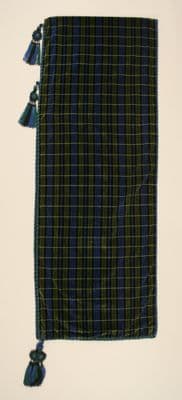
These two pieces trace the long American romance with Scottish tartan, but reveal how radically context transforms meaning. The Victorian silk hood, with its deep forest and navy checks and those dangling tassels, carries the Gothic Revival's obsession with medieval authenticity—this is tartan as costume drama, precious and historically performative.

These two pieces trace the long American romance with Scottish tartan, but reveal how radically context transforms meaning. The Victorian silk hood, with its deep forest and navy checks and those dangling tassels, carries the Gothic Revival's obsession with medieval authenticity—this is tartan as costume drama, precious and historically performative.