SMITHSONIAN
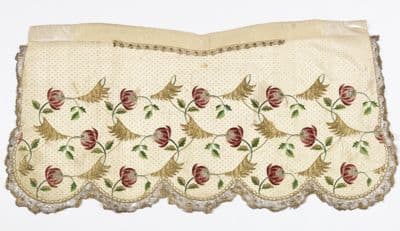
Cream Silk Apron with Burgundy Rose Brocade
Baroque · 1700s · French
Production
handmade
Material
silk
Culture
French
Influences
French silk weaving tradition · Rococo naturalistic florals
This silk apron features a cream ground with an all-over floral pattern of burgundy roses and green foliage rendered in what appears to be brocaded or embroidered technique. The rectangular panel is finished with elaborate scalloped edges trimmed in metallic gold thread or narrow braid. The waistband shows decorative stitching or small-scale patterning. The floral motifs are naturalistically rendered with shaded petals and curved stems, typical of 18th-century French textile design. The scalloped border creates a sophisticated finish that elevates this from purely functional to ornamental dress accessory, reflecting the Rococo period's emphasis on decorative refinement in domestic settings.
dress
Connected To
Worn with·chemiseWorn with·gownWorn with·petticoatWorn with·staysTechnique·hand-embroidery
SHARED50 years · cross-culture · cross-category
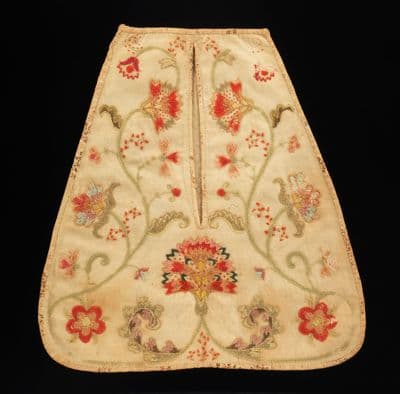
These two pieces reveal how the same decorative impulse traveled from French luxury to American practicality across half a century. The baroque apron's burgundy roses cascade in formal, symmetrical sprays across cream silk, while the rococo pocket translates that floral vocabulary into more naturalistic blooms scattered across humble linen—both pieces anchored by the same scalloped edges that frame their botanical fantasies.
Text
Worn with·chemiseWorn with·gownWorn with·stays
SHARED80 years · cross-culture · cross-category
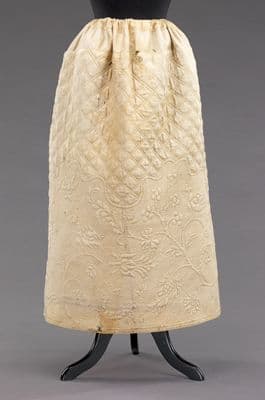
The quilted petticoat's geometric diamonds and the apron's scattered roses represent two competing philosophies of feminine ornament separated by nearly a century of taste. Where the French apron indulges in naturalistic blooms that seem to tumble across silk in rococo abandon, the American petticoat disciplines its beauty into precise, mathematical channels—each quilted line a small rebellion against decorative excess.
Worn with·chemiseWorn with·gownWorn with·petticoat
SHARED40 years · cross-culture · cross-category
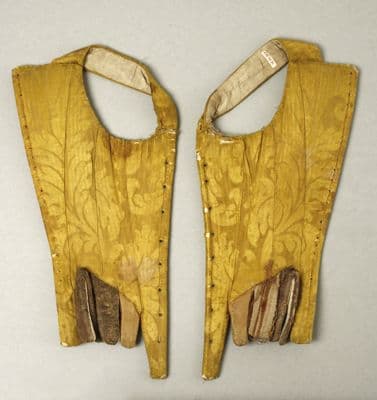
These two pieces speak the same language of 18th-century luxury, but with different accents. The golden stays, with their meticulous quilting that follows the damask's woven pattern, represent the structured foundation of aristocratic dress — every line engineered to shape the torso into the period's coveted silhouette.
Worn with·chemiseWorn with·staysTechnique·brocade-weaving
SHARED80 years · cross-culture
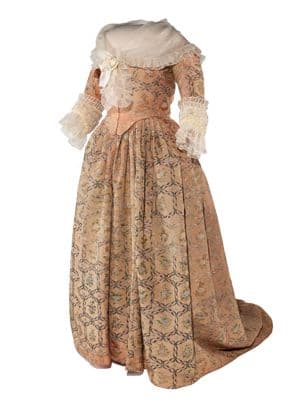
The coral silk brocade of Martha Washington's gown and the delicate rose pattern scattered across this French apron reveal how luxury textiles migrated from intimate undergarments to public dress across the Atlantic. Both fabrics share that distinctive 18th-century obsession with small-scale floral motifs woven in silk—the apron's burgundy roses echoing in miniature the botanical richness that would later bloom into the fuller, more confident patterns adorning American first ladies.
Echoes Across Time
Rococo → Baroque · 50yr72%
SHARED
These two pieces reveal how the same decorative impulse traveled from French luxury to American practicality across half a century. The baroque apron's burgundy roses cascade in formal, symmetrical sprays across cream silk, while the rococo pocket translates that floral vocabulary into more naturalistic blooms scattered across humble linen—both pieces anchored by the same scalloped edges that frame their botanical fantasies.
Worn with·chemiseWorn with·gownWorn with·petticoat
Pull the Thread→
Follow this garment wherever the graph leads