V&A
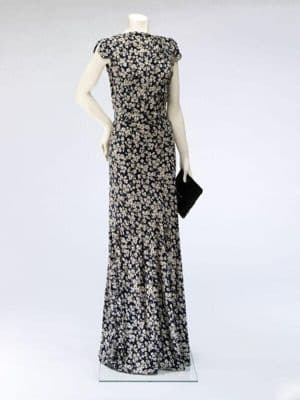
Black and White Printed Silk Evening Gown
Great Depression · 1930s · French
Designer
Mainbocher
Production
haute couture
Material
silk crêpe de Chine
Culture
French
Influences
bias-cut technique · Madeleine Vionnet draping methods
A floor-length evening gown cut on the bias, creating a fluid silhouette that skims the body without excessive volume. The dress features a high neckline with cap sleeves and is constructed from silk crêpe de Chine printed with an all-over floral pattern in white on black ground. The bias construction allows the lightweight fabric to drape naturally, creating subtle movement and a column-like silhouette characteristic of 1930s evening wear. The print appears to be small-scale florals or botanical motifs distributed evenly across the surface. The dress extends to floor length, typical of formal 1930s evening wear, with the bias cut eliminating the need for excessive seaming while providing a sophisticated, streamlined appearance that reflects the decade's preference for sleek, body-conscious silhouettes.
dresscolumnhigh neckfloor length
Connected To
Worn with·evening accessoriesWorn with·undergarmentsFunction·formal-evening
Pull the Thread→
Follow this garment wherever the graph leads