FASHIONPEDIA
Black White Geometric Floral A-Line Slip Dress
2010s · 2020s · Western
Production
ready-to-wear
Material
cotton blend
Culture
Western
Movement
Art Deco · Gorpcore
Influences
Art Deco graphic design · 1920s drop waist silhouette
A sleeveless slip dress featuring bold black geometric and stylized floral motifs printed on white cotton blend fabric. The garment displays the characteristic 1920s straight silhouette with a dropped waist that sits at the hips rather than the natural waistline. The dress falls to approximately mid-calf length with a simple A-line cut that skims the body without fitted shaping. The neckline appears to be a simple scoop or boat neck, and the armholes are cut wide in the typical 1920s fashion. The geometric print shows Art Deco influence with angular, stylized botanical forms arranged in a repeating pattern across the fabric surface.
dressa-linescoop neckmidi
Connected To
Movement·Art Deco
SHARED100 years · cross-culture
These dresses are separated by nearly a century, yet both pulse with the same Art Deco heartbeat—that obsession with geometric pattern as pure ornament. The 1920s wedding dress transforms silk into a golden tapestry of interlocking motifs, every surface claimed by embroidered geometry, while the contemporary slip dress distills that same impulse into crisp black-and-white graphics that march across cotton in clean, modernist formations.
Echoes Across Time
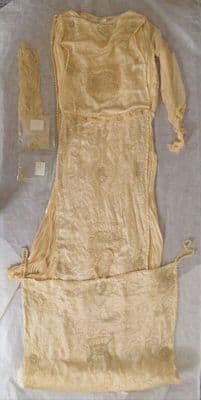
2010s → Roaring Twenties / Art Deco · 100yr56%
SHARED
These dresses are separated by nearly a century, yet both pulse with the same Art Deco heartbeat—that obsession with geometric pattern as pure ornament. The 1920s wedding dress transforms silk into a golden tapestry of interlocking motifs, every surface claimed by embroidered geometry, while the contemporary slip dress distills that same impulse into crisp black-and-white graphics that march across cotton in clean, modernist formations.
Movement·Art Deco
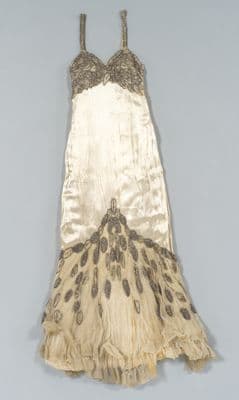
Roaring Twenties / Art Deco → 2010s
Pull the Thread→
Follow this garment wherever the graph leads