Roaring Twenties / Art Deco · 1920s · British
Production
handmade
Material
silk satin
Culture
British
Movement
Art Deco
Influences
Art Deco geometric patterns · 1920s drop-waist construction
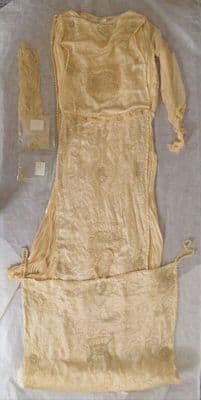
This 1920s wedding ensemble displays the characteristic drop-waist silhouette of the era, with a straight-cut dress that falls loosely from the shoulders. The golden silk satin fabric is extensively decorated with intricate embroidered patterns covering the entire surface. The dress features long fitted sleeves and appears to reach mid-calf length, typical of 1920s proportions. The matching headdress or veil component shows similar embroidered detailing. The overall construction reflects the decade's departure from corseted Victorian styles toward more relaxed, geometric forms that allowed for greater freedom of movement while maintaining ceremonial grandeur through rich surface ornamentation.


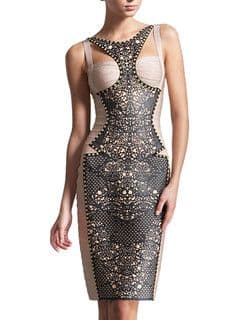
These two dresses speak the same geometric language across nine decades, both channeling Art Deco's obsession with angular patterns and linear repetition. The 1920s golden silk original shows hand-embroidered chevrons and diamond motifs cascading down its drop-waisted silhouette, while the contemporary black knit translates those same zigzag rhythms into textured fabric manipulation—proof that Deco's mathematical beauty never really left the runway.

Follow this garment wherever the graph leads
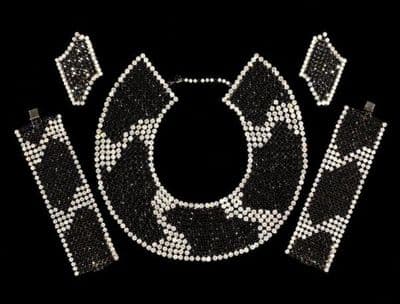
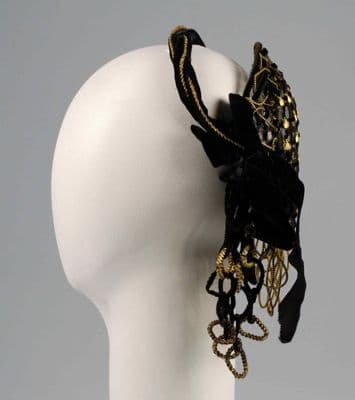
These pieces capture the Art Deco moment when geometric precision became glamour's new language, whether worked in gold thread across silk satin or beaded in metallic accents against black. The headdress's angular, architectural ornament and the dress's geometric embroidery patterns both speak to that 1920s obsession with machine-age aesthetics made luxurious through painstaking handwork.
These two dresses speak the same geometric language across nine decades, both channeling Art Deco's obsession with angular patterns and linear repetition. The 1920s golden silk original shows hand-embroidered chevrons and diamond motifs cascading down its drop-waisted silhouette, while the contemporary black knit translates those same zigzag rhythms into textured fabric manipulation—proof that Deco's mathematical beauty never really left the runway.
The black dress's crystalline beadwork and the golden silk's embroidered medallions both speak the same geometric language—Art Deco's obsession with radiating sunbursts, chevrons, and diamond grids that turned the female form into a glittering architectural statement.
That golden twenties dress and the 1980s rhinestone collar are both drunk on the same geometric high — angular Art Deco patterns that slice through curves with mathematical precision. The dress whispers its geometry through delicate silk embroidery, while the necklace screams it in black and white rhinestones, but both are obsessed with the same sharp-edged vocabulary of diamonds, chevrons, and stepped pyramids.

The black dress's crystalline beadwork and the golden silk's embroidered medallions both speak the same geometric language—Art Deco's obsession with radiating sunbursts, chevrons, and diamond grids that turned the female form into a glittering architectural statement.