2010s · 2020s · Western
Production
ready-to-wear
Material
silk chiffon
Culture
Western
Movement
Art Deco · Gorpcore
Influences
1920s drop-waist construction · Art Nouveau floral motifs
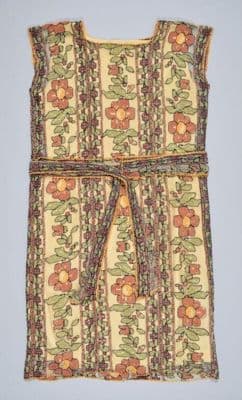
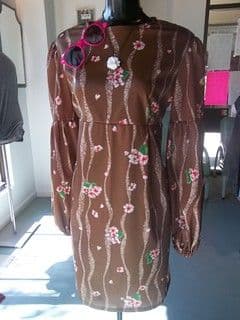
A brown silk chiffon dress featuring the characteristic 1920s drop-waist silhouette with a straight, loose-fitting body that falls to mid-calf length. The garment displays an all-over floral print with pink, green, and white flowers scattered across the brown ground. The dress has long sleeves with gathered cuffs and a round neckline. The lightweight chiffon fabric creates a flowing drape typical of the period's rejection of corseted construction. The print appears to be applied through a resist or block-printing technique, creating distinct floral motifs that reflect the era's embrace of decorative arts and nature-inspired designs.
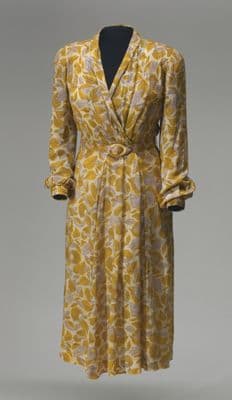
These two dresses share the gentle democracy of the wrap silhouette, that most forgiving of cuts that skims rather than clings. The brown chiffon's scattered blooms echo the golden yellow's leafy sprawl, both employing small-scale florals that read as texture from a distance but reveal their botanical secrets up close.

These two dresses share the gentle democracy of the wrap silhouette, that most forgiving of cuts that skims rather than clings. The brown chiffon's scattered blooms echo the golden yellow's leafy sprawl, both employing small-scale florals that read as texture from a distance but reveal their botanical secrets up close.


Follow this garment wherever the graph leads
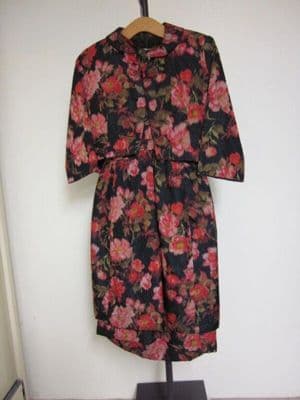
These two dresses speak the same floral language across six decades, but with entirely different accents. The brown chiffon's scattered blooms float weightlessly over its drop-waist silhouette like pressed flowers between glass, while the 1950s ensemble clusters its roses into a dense, almost suffocating garden that hugs every curve.
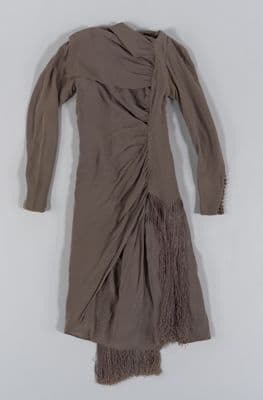
These dresses are bound by the democracy of drape—both cut to skim rather than sculpt the body, though separated by eight decades and entirely different intentions. The brown chiffon's scattered florals and drop waist whisper of 1920s revival romance, while the gray jersey's asymmetrical wrap and attached shawl speak the practical poetry of wartime rationing, when every yard of fabric had to earn its keep.
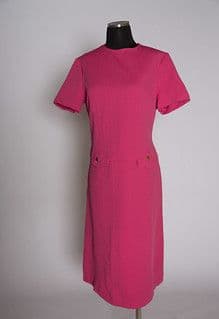
The brown chiffon dress floats over its wearer with the same calculated insouciance as the pink sheath hugs its figure—both demanding the architectural support of proper undergarments to achieve their intended silhouettes. Where the 1950s dress relies on the clean geometry of darts and seaming to create its body-conscious line, the 2010s piece uses transparency and delicate floral embroidery to suggest rather than define the form beneath.
These two dresses speak the same floral language across six decades, but with entirely different accents. The brown chiffon's scattered blooms float weightlessly over its drop-waist silhouette like pressed flowers between glass, while the 1950s ensemble clusters its roses into a dense, almost suffocating garden that hugs every curve.