1950s · 1950s · African American
Production
handmade
Material
synthetic fiber
Culture
African American
Movement
New Look · New Look / Post-War
Influences
Christian Dior New Look silhouette
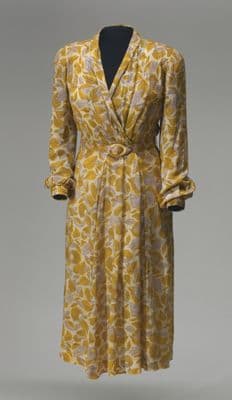
A golden yellow wrap dress featuring an all-over white floral or leaf pattern. The dress has a classic 1950s silhouette with a fitted bodice that wraps across the front, three-quarter length sleeves, and a full skirt that falls to mid-calf. The synthetic fabric appears lightweight with a subtle sheen. The wrap closure creates a V-neckline and is secured with a self-fabric tie at the waist. The sleeves are fitted through the forearm with slight gathering at the shoulder. The full skirt exemplifies the New Look silhouette popularized in the post-war era, emphasizing a feminine hourglass shape with its cinched waist and voluminous lower portion.


These two dresses speak across six decades through the DNA of Dior's New Look—that revolutionary 1947 silhouette that democratized elegance and traveled from Paris salons to American sewing rooms. Rosa Parks' golden floral wrap dress, with its fitted bodice and full skirt that pools gracefully at mid-calf, carries the same proportional magic as the cream sleeveless number: both cinch the waist and let fabric bloom outward in that distinctly feminine hourglass that Dior gifted to the world.

Follow this garment wherever the graph leads
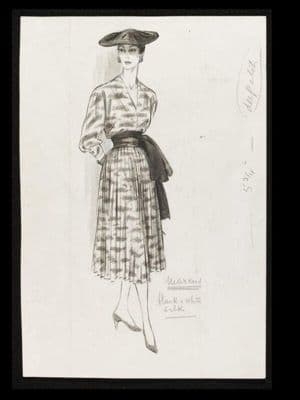
Both dresses echo Dior's New Look through their cinched waists and full skirts, but they tell radically different stories of 1950s resourcefulness. Rosa Parks' golden floral wrap dress, with its careful draping and polished synthetic fabric, speaks to the aspirational elegance of Black middle-class women who understood that presentation was both personal pride and political armor.
These dresses reveal how Dior's New Look traveled beyond Paris salons into everyday American life, carrying the same DNA of cinched waists and full skirts but expressed through different hands and means.
Both dresses bear the DNA of Dior's New Look—that cinched waist and full skirt that swept America in the late 1940s and held firm through the fifties—but they tell vastly different stories about who got to participate in fashion's democratic promise.
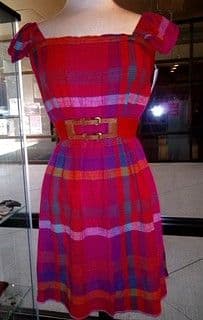
These two 1950s dresses reveal how Dior's New Look democracy worked in practice — the red plaid cotton with its crisp belt and structured bodice channels the same cinched-waist, full-skirt formula as Rosa Parks' golden wrap dress, but where one speaks in primary-colored American optimism, the other whispers in sophisticated mustard florals.

Both dresses bow to Dior's New Look, but from opposite ends of the American dream. Parks' golden wrap dress, with its cinched waist and graceful midi length, captures the 1950s silhouette in humble synthetic fabric—the kind of elegant domesticity that Black women like her could sew for themselves when department stores wouldn't serve them.