1950s · 1950s · American
Production
ready-to-wear
Material
cotton
Culture
American
Movement
New Look / Post-War
Influences
Christian Dior New Look silhouette
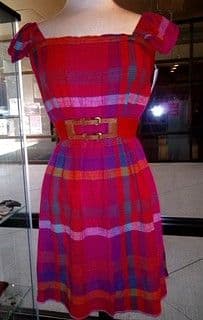
A cotton day dress featuring a vibrant plaid pattern in red, purple, and pink tones. The dress has a fitted bodice with a straight-across neckline and short cap sleeves with small bow details at the shoulders. A wide belt with a rectangular buckle cinches the natural waistline, emphasizing the New Look silhouette. The skirt portion flares out in an A-line shape, falling to approximately knee length. The plaid pattern consists of large blocks of color creating a bold geometric design typical of 1950s casual wear. The construction appears to be machine-sewn with clean, structured lines that reflect the era's emphasis on defined waistlines and feminine proportions.


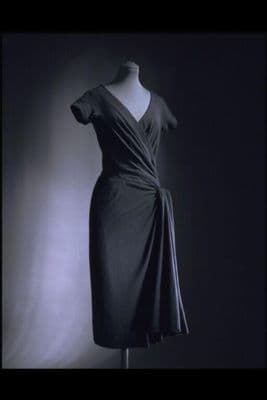
The black pencil skirt and plaid fit-and-flare dress are separated by seven decades but united by Dior's revolutionary New Look silhouette—both cinch the waist to create that coveted hourglass shape, though the '50s dress achieves it through a fitted bodice that blooms into a full skirt while the contemporary skirt hugs every curve in sleek ponte knit.


Follow this garment wherever the graph leads
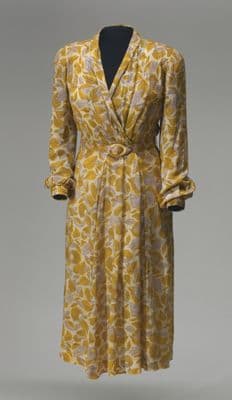
These two 1950s dresses reveal how Dior's New Look democracy worked in practice — the red plaid cotton with its crisp belt and structured bodice channels the same cinched-waist, full-skirt formula as Rosa Parks' golden wrap dress, but where one speaks in primary-colored American optimism, the other whispers in sophisticated mustard florals.
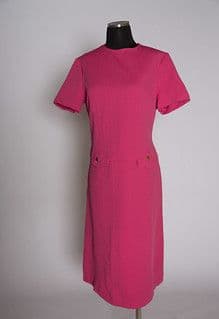
These two dresses reveal the split personality of 1950s femininity — one playing the part of the spirited American girl, the other channeling European sophistication. The plaid cotton number with its square neckline and gathered skirt speaks the language of suburban optimism, while the fuchsia wool crepe sheath whispers Parisian restraint with its clean lines and subtle waist buttons.
These dresses capture the two faces of 1950s femininity — one all American optimism in candy-bright plaid with its perky bow sleeves and cinched waist, the other embodying French sophistication through that liquid drape and architectural wrap construction. The plaid cotton speaks to postwar abundance and the suburbs, while the gray jersey whispers of Left Bank elegance, yet both worship at the same altar of the defined waist that Dior made gospel.
Both garments spring from Dior's New Look revolution, but they tell the story from opposite ends of the fashion spectrum. The plaid cotton dress translates the New Look's cinched waist and full skirt into cheerful American ready-to-wear, complete with that characteristic wide belt and feminine bow details that made Parisian haute couture accessible to suburban closets.
Both dresses worship at the altar of Dior's New Look, but sixty years apart they reveal how differently each era interpreted feminine power.