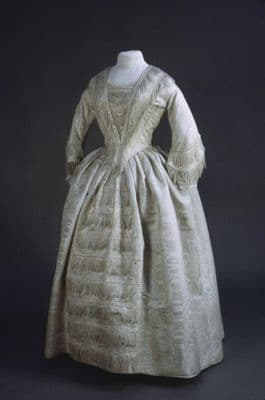
Victorian Early / Crinoline · 1850s · French
Production
handmade
Material
watered silk
Culture
French
Influences
1850s crinoline silhouette
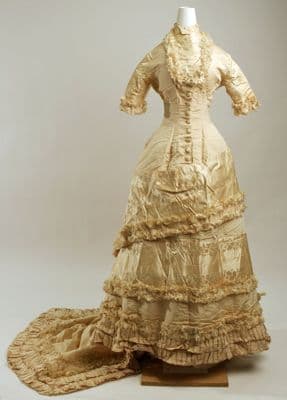
This 1851 French wedding dress exemplifies mid-Victorian formal wear with its characteristic silhouette of fitted bodice and voluminous skirt. The ivory watered silk creates a lustrous, rippled surface texture typical of moiré fabric. The bodice features a square neckline with elaborate lace trim and silk fringe detailing that cascades down the front panel. Three-quarter length sleeves are fitted through the forearm with gathered fullness at the shoulder. The skirt extends in a perfect bell shape, supported by crinolines underneath, with horizontal bands of matching lace and fringe trim creating visual weight and movement. The construction demonstrates the period's emphasis on structured undergarments to achieve the desired dome-like silhouette that defined 1850s feminine fashion.


These two wedding gowns reveal how bridal luxury evolved from Victorian restraint to Edwardian theatricality. The earlier French dress relies on the subtle shimmer of watered silk and precise lace trim for its impact—elegant but understated, letting the fabric's inherent richness speak.

Follow this garment wherever the graph leads
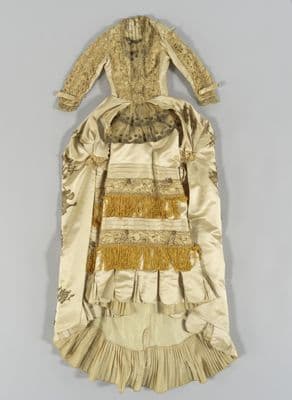
These two wedding gowns reveal how drastically the Victorian silhouette morphed over three decades, yet both deploy silk's reflective properties as their secret weapon. The earlier French dress uses watered silk's subtle shimmer and horizontal pleating to create gentle volume that flows from a fitted bodice, while the later American gown abandons subtlety entirely—its cream taffeta catches light off every ruffle, flounce, and gathered tier that builds the bustle's dramatic backward projection.
These two wedding gowns reveal how bridal luxury evolved from Victorian restraint to Edwardian theatricality. The earlier French dress relies on the subtle shimmer of watered silk and precise lace trim for its impact—elegant but understated, letting the fabric's inherent richness speak.
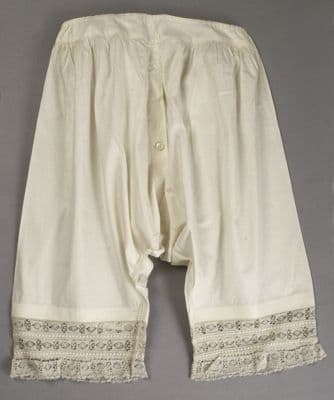
These two garments reveal the Victorian obsession with lace as the ultimate marker of refinement, whether hidden or displayed. The drawers' delicate bands of insertion lace at the hem were meant for no one's eyes but the wearer's own—a private luxury that speaks to the era's belief that proper ladies should be beautiful down to their most intimate layers.
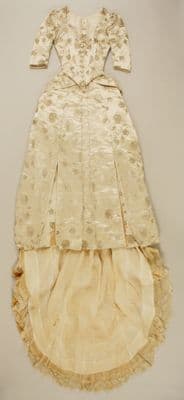
The cream brocade gown's dramatically bustled silhouette and the ivory watered silk's bell-shaped crinoline mark the bookends of Victorian fashion's most extreme experiments with volume—one pushing fabric backward into a shelf-like protrusion, the other inflating it into a perfect dome.

These two gowns share the Victorian obsession with surface embellishment as status symbol, but their execution reveals how dramatically fashion's relationship to labor has shifted. The 19th-century wedding dress deploys watered silk's lustrous ripple and intricate lacework as monuments to hand-crafted luxury—every pleat and trim a testament to hours of skilled needlework.