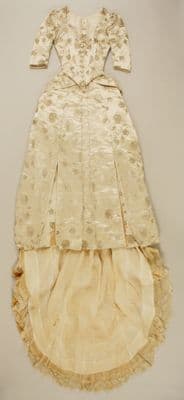
Victorian Late / Bustle · 1880s · French
Production
haute couture
Material
silk brocade
Culture
French
Influences
French court dress tradition · bustle silhouette
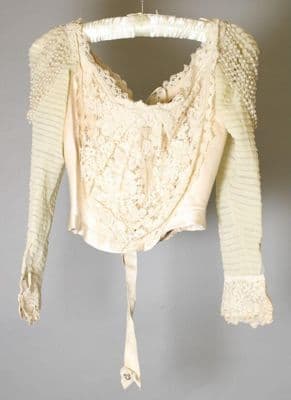
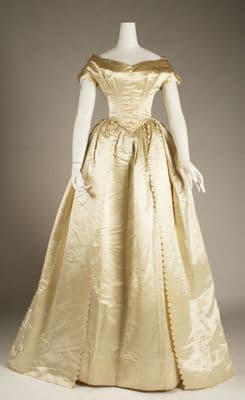
This 1880s French ball gown exemplifies the height of bustle era fashion with its characteristic silhouette featuring a tightly fitted bodice and dramatically trained skirt. The cream silk brocade displays an elaborate woven pattern throughout, likely featuring floral or foliate motifs typical of the period. The bodice shows the pointed waistline characteristic of the 1880s, with what appears to be three-quarter length sleeves. The skirt extends into a substantial train that would have been supported by an internal bustle structure, creating the fashionable backward projection of fabric. The overall construction demonstrates the formal court dress traditions of French haute couture, with its emphasis on luxurious materials and complex structural engineering to achieve the desired silhouette.


These two gowns speak the same language of bridal luxury across fifty years, but with entirely different accents. The earlier American wedding dress whispers its elegance through that liquid silk satin and the demure off-shoulder neckline that barely hints at décolletage, while the later French ballgown shouts opulence through its elaborate brocade and that dramatic bustle silhouette that transforms the wearer into a gilded monument.
Follow this garment wherever the graph leads
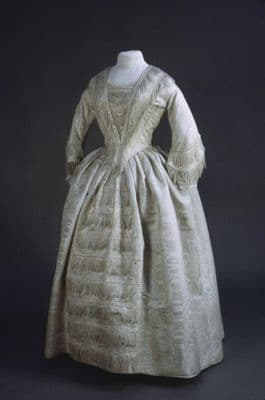
These two cream confections show how Victorian excess mellowed into Edwardian restraint, though both required the same architectural undergarments to achieve their silhouettes. The earlier French gown drowns its wearer in cascading brocade and that dramatic bustle train—pure theater meant to consume space and attention—while the American bodice twenty years later pulls back to a more controlled opulence, its rows of tiny buttons and delicate lace suggesting refinement over spectacle.
These two gowns speak the same language of bridal luxury across fifty years, but with entirely different accents. The earlier American wedding dress whispers its elegance through that liquid silk satin and the demure off-shoulder neckline that barely hints at décolletage, while the later French ballgown shouts opulence through its elaborate brocade and that dramatic bustle silhouette that transforms the wearer into a gilded monument.
The cream brocade gown's dramatically bustled silhouette and the ivory watered silk's bell-shaped crinoline mark the bookends of Victorian fashion's most extreme experiments with volume—one pushing fabric backward into a shelf-like protrusion, the other inflating it into a perfect dome.
These two cream silk pieces chart the Victorian woman's evolving relationship with her own body across three decades of corsetry. The earlier English bodice, with its severe pointed waist and geometric seaming, treats the torso like architectural scaffolding—every line designed to compress and redirect. The later French ball gown's bodice, meanwhile, flows with a softer sensuality, its brocaded surface suggesting curves rather than demanding them.


These two pieces reveal how the French obsession with waist manipulation evolved from architectural drama to subtle seduction. The Victorian gown's fitted bodice creates that signature bustle-era silhouette through rigid boning and precise tailoring, while the 1950s waspie achieves the same cinched effect with delicate lace stretched over a foundation—both demanding the same engineering precision, just seventy years apart.