Victorian Early / Crinoline · 1850s · English
Production
handmade
Material
silk
Culture
English
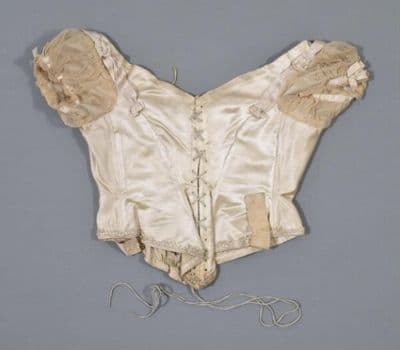
This cream silk bodice demonstrates mid-Victorian construction with its characteristic pointed waist and fitted silhouette. The garment features front lacing through metal eyelets, allowing for precise fit adjustment over a corset. Short cap sleeves are gathered and trimmed with self-fabric ruffles. The neckline is modest with a shallow scoop front. Interior construction shows careful boning channels and cotton tape reinforcement at stress points. The bodice extends to a sharp point at the center front waist, typical of 1850s fashion. Fabric appears to be a lightweight silk, possibly taffeta, showing age-related discoloration. Multiple tie strings suggest it was worn with a separate skirt as part of a two-piece ensemble.


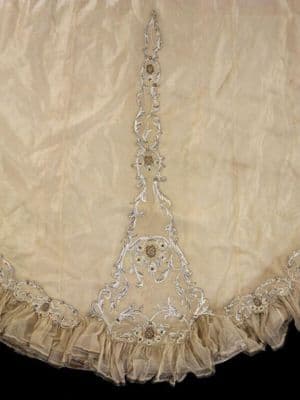
That Victorian bodice's maze of silk-covered buttons marching down the front and the Edwardian gown's cascade of pearl-dotted embroidery speak the same language of feminine armor—both demand patience from their wearers and telegraph prosperity through sheer labor intensity.

Follow this garment wherever the graph leads
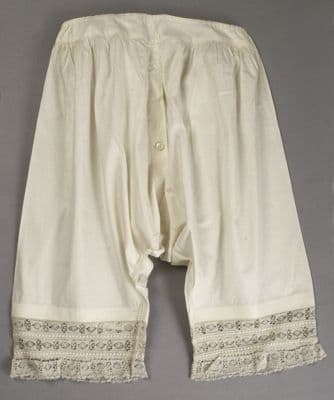
These cream-colored Victorian undergarments reveal how intimacy with lace evolved across the 19th century. The drawers' delicate eyelet trim at the hem speaks to the later Victorian obsession with hidden luxury—private indulgence meant only for the wearer and perhaps a lady's maid.
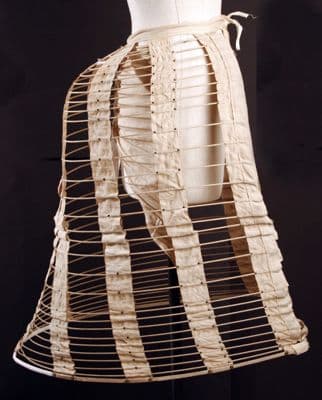
These two garments reveal the Victorian woman's daily negotiation with architectural undergarments, separated by roughly two decades and an ocean but united in their commitment to reshaping the female form through engineering.
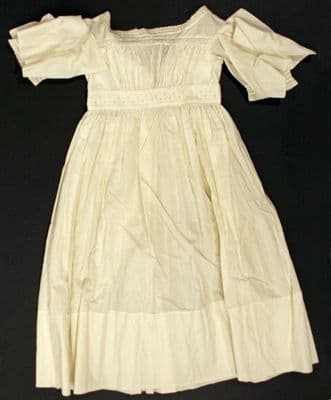
Both garments speak the same language of romantic femininity through their cream silk and cotton, their carefully gathered sleeves, and their devotion to the fitted bodice—but they represent two different moments in that conversation. The chemise dress, with its empire waist and flowing skirt, captures the tail end of neoclassical simplicity, while the Victorian bodice, with its precise boning channels and multiple hook-and-eye closures, announces the return of structured artifice.
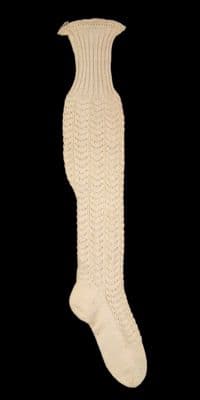
These cream-colored intimates speak the same Victorian language of structured femininity, separated by two decades of evolving silhouettes. The bodice's precise rows of buttons and boned construction create the same disciplined geometry as the stocking's tight ribbing—both garments designed to compress, support, and shape the female form into period-appropriate curves.