Victorian Late / Bustle · 1870s-1880s · American
Production
handmade
Material
silk taffeta
Culture
American
Influences
French Second Empire court dress · bustle cage engineering
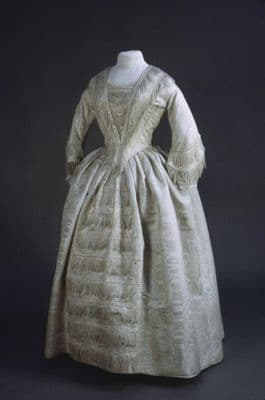
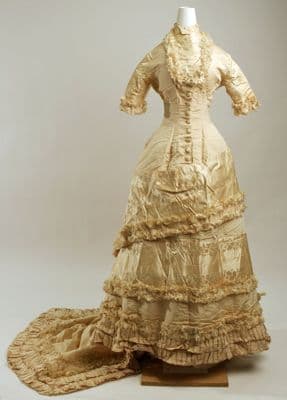
This cream silk taffeta wedding gown exemplifies 1870s bustle construction with its fitted bodice featuring a high neckline and three-quarter sleeves trimmed with ruched silk bands. The bodice extends into a pointed waist over a dramatically bustled skirt constructed in multiple tiers. Each tier features deep box pleats and ruched trim creating horizontal emphasis. The skirt extends into a substantial train with cascading ruffles and gathered fabric panels. The surface is entirely covered in self-fabric manipulation through pleating, ruching, and tiered construction rather than applied decoration. The silhouette demonstrates the period's engineering of the bustle support system, creating the characteristic shelf-like projection at the back while maintaining a smooth front profile.


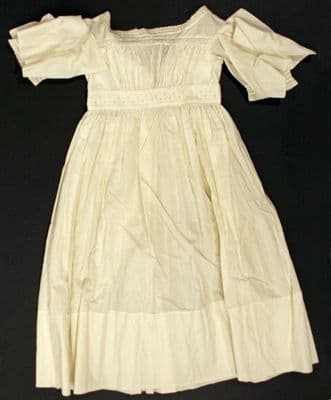
These two cream dresses reveal how the Romantic era's cotton simplicity mutated into Victorian excess through the same foundational DNA. The earlier chemise dress, with its gathered neckline and puffy sleeves, established the blueprint for feminine volume that the later bustle gown exploded into theatrical layers of silk taffeta ruffles cascading down a trained skirt.
Follow this garment wherever the graph leads
These two wedding gowns reveal how drastically the Victorian silhouette morphed over three decades, yet both deploy silk's reflective properties as their secret weapon. The earlier French dress uses watered silk's subtle shimmer and horizontal pleating to create gentle volume that flows from a fitted bodice, while the later American gown abandons subtlety entirely—its cream taffeta catches light off every ruffle, flounce, and gathered tier that builds the bustle's dramatic backward projection.
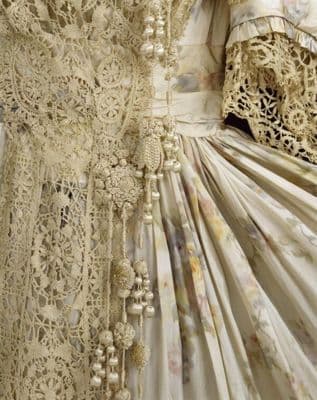
The Victorian gown's cascading tiers of silk taffeta ruffles and the Edwardian dress's explosion of Battenberg lace both speak the same language of bridal excess — more is more, and then more again.
These two cream dresses reveal how the Romantic era's cotton simplicity mutated into Victorian excess through the same foundational DNA. The earlier chemise dress, with its gathered neckline and puffy sleeves, established the blueprint for feminine volume that the later bustle gown exploded into theatrical layers of silk taffeta ruffles cascading down a trained skirt.
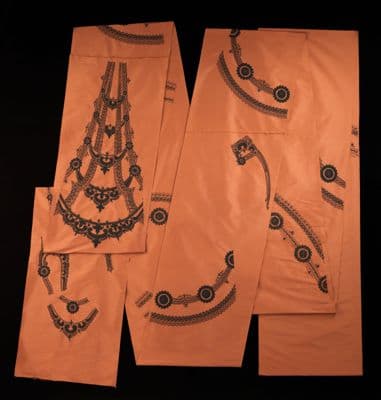
These two pieces reveal the Victorian obsession with surface decoration taken to opposite extremes. The cream wedding gown drowns in its own abundance—cascading ruffles, gathered swags, and frothy trim that pile up like meringue, creating texture through sheer volume. The coral habit's pattern pieces, by contrast, show how French dressmakers achieved similar richness through strategic placement of dark braided trim that maps the body's curves with surgical precision.


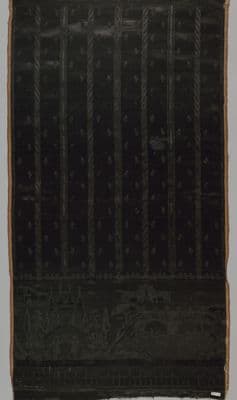
The Victorian bustle gown's cascading tiers of cream silk and that Spanish velvet panel's geometric quilting both deploy the same fundamental strategy: using repetitive surface manipulation to transform flat fabric into sculptural architecture. Where the 18th-century Spanish piece creates rigid geometric order through its diamond-quilted grid, the American wedding dress a century later uses gathered ruffles to build organic, wave-like volume that flows from fitted bodice to dramatic train.