Victorian Late / Bustle · 1870s · American or European
Production
handmade
Material
cotton lawn
Culture
American or European
Influences
1870s wrapper tradition · Victorian domestic dress
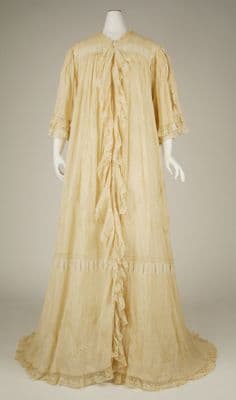
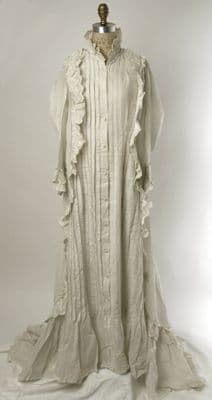
A floor-length cotton negligée featuring extensive ruffled trim cascading down the front opening and adorning the high neckline. The garment displays characteristic 1870s construction with a loose, unstructured bodice that flows into a trained skirt. Multiple tiers of gathered ruffles create vertical emphasis along the center front closure, while similar ruffled detailing frames the stand-up collar. The sleeves appear full at the shoulder with ruffled cuffs. This wrapper represents the Victorian era's elaborate approach to private dress, where even intimate garments required decorative elements. The lightweight cotton fabric and extensive hand-finished ruffling demonstrate the period's emphasis on feminine domesticity and the hours devoted to maintaining such garments.
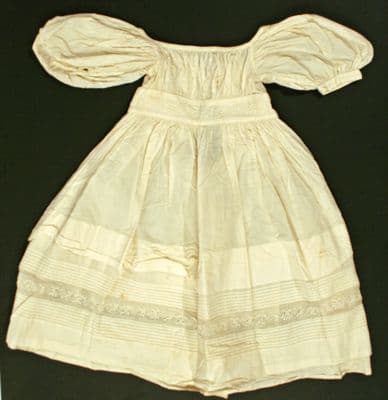
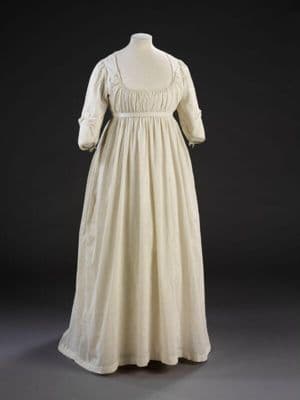
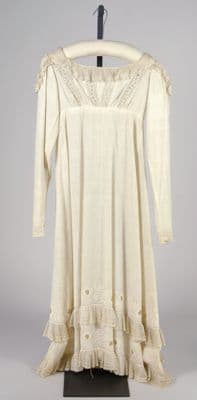
These two white cotton garments speak the same language of innocence, separated by half a century and a continent's worth of changing ideas about purity. The earlier child's dress, with its high Empire waist and puffed sleeves, carries the Romantic era's belief that children were naturally virtuous—notice how the simple cotton muslin and restrained trim suggest an untouched state.

These two white cotton garments speak the same language of innocence, separated by half a century and a continent's worth of changing ideas about purity. The earlier child's dress, with its high Empire waist and puffed sleeves, carries the Romantic era's belief that children were naturally virtuous—notice how the simple cotton muslin and restrained trim suggest an untouched state.


Follow this garment wherever the graph leads
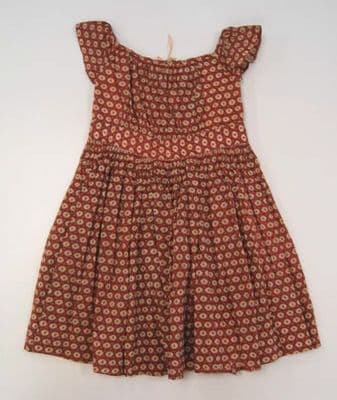
These two garments reveal how Victorian cotton construction bridged the nursery and the boudoir through identical techniques of gathering and ruffling. The child's rust calico dress uses the same knife-pleated ruffle application and gathered waistline seaming as the ivory negligée, but where the nightgown's ruffles cascade dramatically from neck to hem like a waterfall of cotton lawn, the little dress keeps its frills contained to shoulders and skirt—propriety scaled down for small hands.
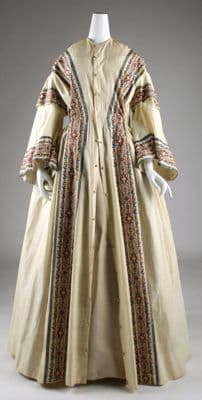
These two cotton robes trace the Victorian woman's private sphere across three decades, from the geometric precision of the earlier dressing gown's burgundy and gold braid to the later negligée's cascade of self-ruffles that spill like cream down its front and sleeves.
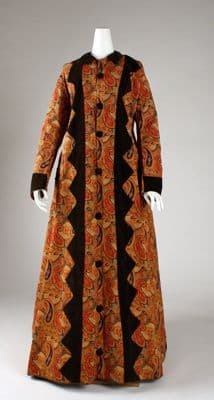
These two robes reveal the Victorian era's split personality about domestic undress — one channeling angelic purity, the other embracing exotic indulgence. The cotton negligée, with its cascade of ruffles and pristine whiteness, performs innocence even in private moments, while the paisley dressing gown boldly appropriates Eastern motifs in rich rust and amber, its geometric borders suggesting a worldly sophistication that the white robe's frothy romanticism deliberately rejects.
These two undergarments mark the dramatic shift from Victorian excess to wartime practicality. The ivory negligée, with its cascading ruffles and acres of cotton lawn, embodies the era when even nightwear required architectural engineering—notice how those knife-pleated frills create volume that would have rustled with every movement.