Victorian Late / Bustle · 1870s · American
Production
handmade
Material
linen
Culture
American
Movement
Orientalism
Influences
Kashmir shawl patterns · Indian paisley textiles
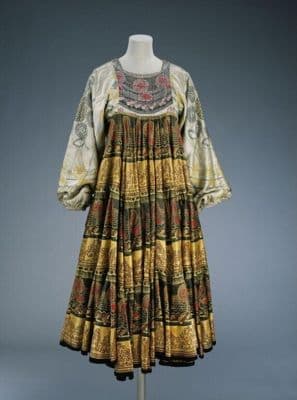
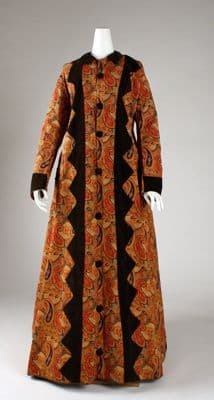
A floor-length dressing gown featuring an intricate paisley pattern in rust orange and golden yellow against black vertical bands. The garment has a fitted bodice with a high neckline and black collar, transitioning to a flowing A-line skirt that reaches the floor. Long fitted sleeves extend to the wrists with black cuffs. The paisley motifs are densely packed and ornate, typical of Victorian textile design influenced by Indian Kashmir shawl patterns. Black vertical stripes create structured panels that frame the paisley sections, giving the garment architectural definition while maintaining the relaxed silhouette appropriate for private wear.
Both garments drink from the same well of Indian paisley motifs, but one sips politely while the other gulps with abandon. The Victorian dressing gown channels colonial fascination through its disciplined vertical bands of rust paisley against black trim—domestic orientalism contained within proper structure and formal tailoring.

Both garments drink from the same well of Indian paisley motifs, but one sips politely while the other gulps with abandon. The Victorian dressing gown channels colonial fascination through its disciplined vertical bands of rust paisley against black trim—domestic orientalism contained within proper structure and formal tailoring.


Follow this garment wherever the graph leads
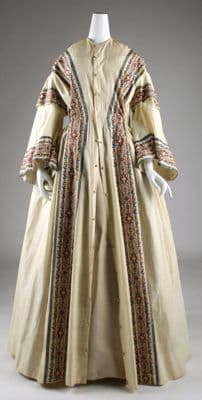
These two dressing gowns reveal how Victorian men's at-home luxury evolved from restrained elegance to full-throttle opulence over three decades. The earlier cream cotton robe whispers its status through delicate burgundy and gold trim that traces the edges like calligraphy, while the later rust paisley number shouts it through an all-over feast of swirling botanicals that transforms the entire garment into a walking tapestry.
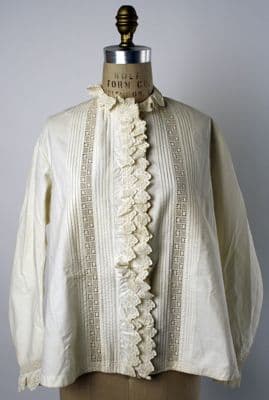
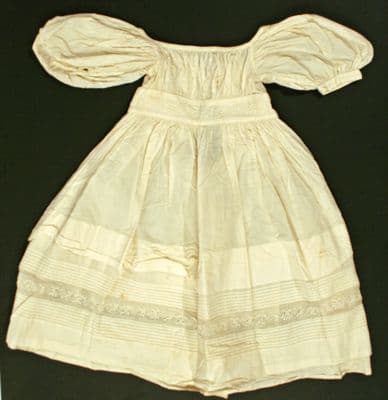
These two Victorian garments reveal the era's rigid hierarchy of undress: the pristine white bed jacket with its ladder of pin tucks and ruffled placket was pure bedroom propriety—think invalid chic or morning toilette—while the paisley dressing gown in burnt orange and black suggests something more louche, a garment for receiving intimate visitors or padding around one's private quarters.
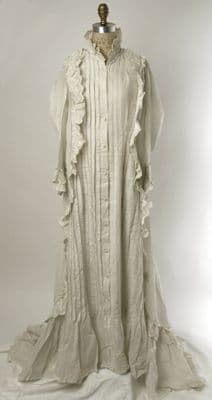
These two robes reveal the Victorian era's split personality about domestic undress — one channeling angelic purity, the other embracing exotic indulgence. The cotton negligée, with its cascade of ruffles and pristine whiteness, performs innocence even in private moments, while the paisley dressing gown boldly appropriates Eastern motifs in rich rust and amber, its geometric borders suggesting a worldly sophistication that the white robe's frothy romanticism deliberately rejects.
These two garments reveal how the empire waist's democratic promise played out across half a century of American domesticity. The child's cream muslin dress, with its gathered sleeves and high waistline sitting just below the bust, carries the same structural DNA as the rust paisley dressing gown's empire silhouette, though the adult garment stretches that proportional logic into a full-length column.