Rococo · 1780s · American
Production
handmade
Material
cotton with whalebone boning
Culture
American
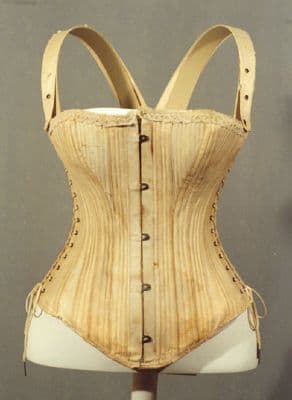
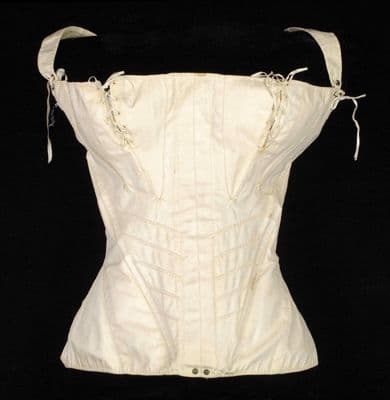
A mid-18th century pair of stays constructed from cream-colored cotton with whalebone boning channels creating vertical structural lines throughout the bodice. The garment features a distinctive off-shoulder design with wide shoulder straps that tie at the shoulders, creating a square neckline. The front closure appears to be laced, with visible eyelets running down the center front. The stays are cut to create a conical torso shape typical of the Rococo period, with a fitted waist that would have extended over the hips. The construction shows clear boning channels stitched into the fabric, providing the rigid structure necessary to shape the female silhouette according to 18th-century ideals.
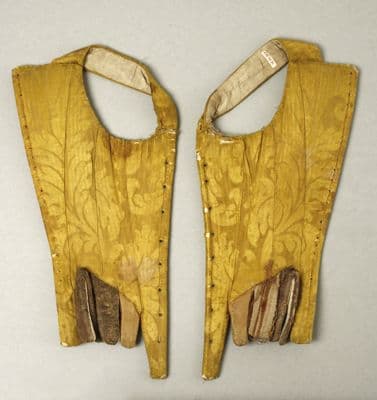
These stays reveal the democratic evolution of 18th-century undergarments: the golden Italian pair flaunts quilted silk damask in an elaborate floral pattern that screams aristocratic luxury, while the later American version strips away the ornament for pure function in practical cotton.

These stays reveal the democratic evolution of 18th-century undergarments: the golden Italian pair flaunts quilted silk damask in an elaborate floral pattern that screams aristocratic luxury, while the later American version strips away the ornament for pure function in practical cotton.

Follow this garment wherever the graph leads
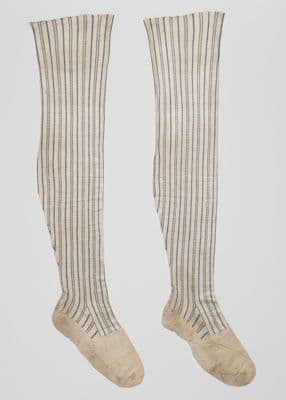
Both garments speak the same language of 18th-century feminine structure, but one builds the body while the other adorns its extremities. The stays, with their precise whalebone channels and shoulder-tie construction, literally reshape the torso into the period's coveted conical silhouette, while the ribbed stockings extend that same architectural logic downward—their vertical striping echoing the stays' linear boning to create an unbroken visual flow from bust to toe.
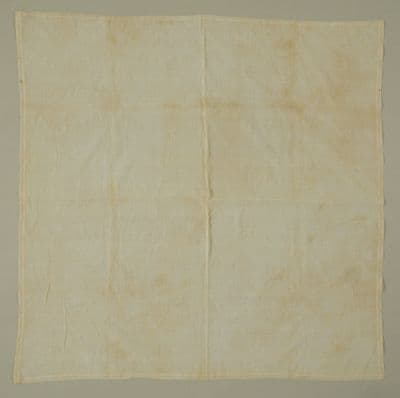
These two pieces reveal how 18th-century American women layered intimacy and modesty with surgical precision. The triangular fichu's crisp folds would have tucked demurely into the stays' severe neckline, the muslin's soft drape a calculated contrast to the corset's rigid architecture of whalebone channels radiating like prison bars across the torso.
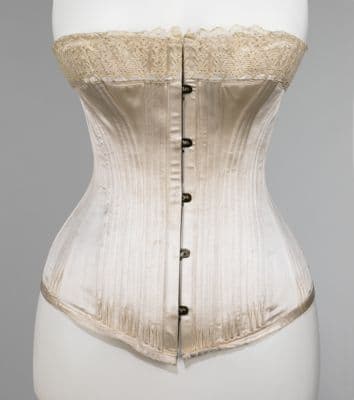
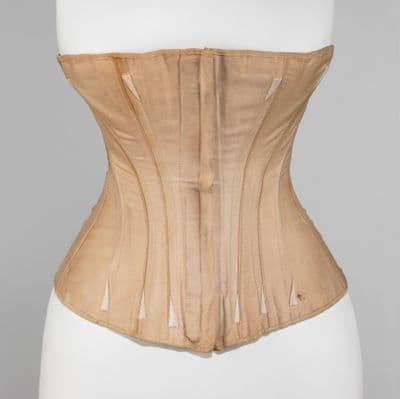
These two corsets share the same obsession with architectural precision—both use rigid vertical boning to create an unnaturally straight, columnar torso that defies the body's natural curves. The 18th-century stays achieve this through visible external lacing and stark geometric lines, while the Victorian corset hides its engineering beneath silk and lace trim, but both demand the same rigid posture and compressed waist.

These two pieces reveal how 18th-century American women layered intimacy and modesty with surgical precision. The triangular fichu's crisp folds would have tucked demurely into the stays' severe neckline, the muslin's soft drape a calculated contrast to the corset's rigid architecture of whalebone channels radiating like prison bars across the torso.