V&A
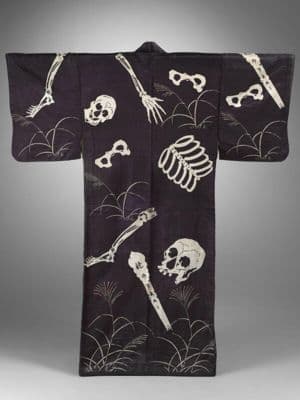
Black Cotton Kosode with Skull and Bones Pattern
Victorian Early / Crinoline · 1840s · Japanese
Production
handmade
Material
cotton satin
Culture
Japanese
Influences
memento mori tradition
A black cotton satin kosode featuring a striking repeat pattern of human skulls and skeletal bones rendered in cream-colored resist-dyed motifs. The design includes full skulls, individual bones, and ribcages scattered across the dark ground in an asymmetrical arrangement. Stylized cloud or wave forms in the same cream tone provide compositional balance between the anatomical elements. The garment follows traditional kosode construction with wide rectangular sleeves and straight-cut body panels. The stencil paste-resist technique creates crisp, clean edges on the motifs against the deep black ground. This represents the Japanese fascination with memento mori imagery during the mid-19th century, when such macabre themes appeared in textiles alongside more conventional nature motifs.
dressstraightfloor length
Connected To
Worn with·obiWorn with·undergarmentsTechnique·resist-dyeingMotif·
Echoes Across Time
Victorian Early / Crinoline → Great Depression · 90yr65%
SHARED
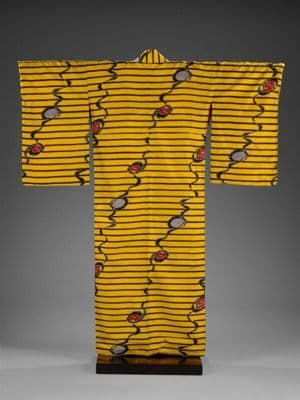
These two kimono reveal how Japanese textile artists weaponized everyday cotton against hard times, turning constraint into creative rebellion. The Victorian-era kosode transforms mortality into decoration—those scattered skulls and bones floating across black cotton like a gothic fever dream, while the Depression-era kimono abstracts its motifs into pure rhythm, yellow stripes punctuated by mysterious organic forms that could be seeds, cells, or hope itself.
Worn with·obiWorn with·undergarmentsTechnique·resist-dyeing
Pull the Thread→
Follow this garment wherever the graph leads