V&A
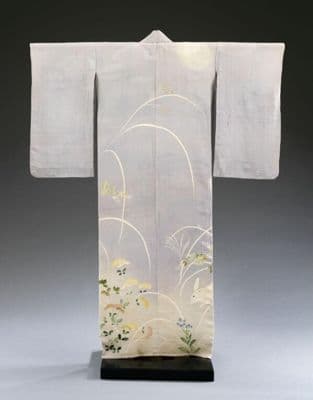
Pale Gray Silk Crepe Kimono with Rabbit Motif
Belle Epoque · 1910s · Japanese
Production
handmade
Material
figured silk crepe
Culture
Japanese
This unlined kimono displays the characteristic T-shaped silhouette with wide rectangular sleeves and straight-cut body panels. The pale gray silk crepe ground features resist-dyed circular motifs creating flowing curved lines across the surface. Delicate rabbits and autumn grasses are rendered in cream, gold, and muted green tones, concentrated in the lower portion following traditional kimono design principles. The lightweight crepe fabric and unlined construction indicate summer wear. The resist-dyeing technique creates soft, organic edges to the motifs, while the figured crepe adds subtle texture. The composition balances negative space in the upper portion with concentrated decoration below, demonstrating refined Taishō period aesthetic sensibilities that blend traditional Japanese motifs with more naturalistic rendering.
dressstraightfloor length
Connected To
Worn with·obiWorn with·undergarmentsTechnique·resist-dyeing
SHARED70 years
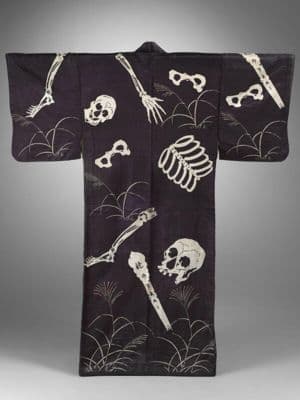
These two kimonos reveal how Japanese textile artists weaponized beauty across vastly different emotional registers. The earlier piece whispers its elegance through pale silk and delicate rabbits scattered like haiku across the hem, while the later garment screams memento mori with skulls and femurs dancing against black cotton—both using the same resist-dyeing technique to achieve their opposite effects.
Text71%
Image80%
Worn with·obiWorn with·undergarments
SHARED100 years
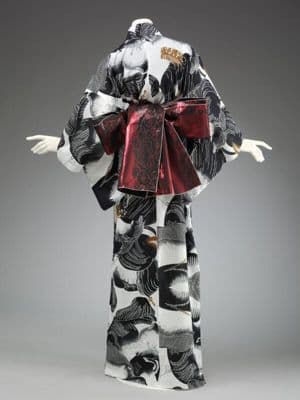
These two kimono reveal how Japanese dress navigated the seismic shift from silk to synthetics across a century. The Belle Epoque piece speaks in silk's native tongue—those rabbits seem to breathe against the pale gray ground, their forms emerging through the fabric's natural drape and sheen.
Worn with·obiTechnique·resist-dyeing
SHARED100 years
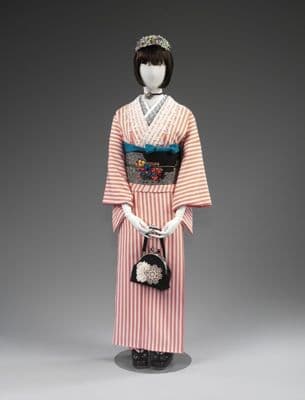
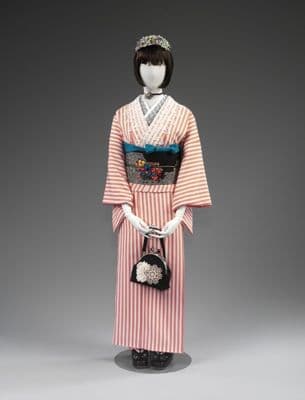
The pink striped cotton kimono and the pale gray silk crepe with its delicate rabbit motif represent the two poles of Japanese textile artistry—one built for daily life, the other for ceremony.
Worn with·obiTechnique·resist-dyeing
SHARED100 years
Text71%
Echoes Across Time
Belle Epoque → Victorian Early / Crinoline · 70yr62%
SHARED
These two kimonos reveal how Japanese textile artists weaponized beauty across vastly different emotional registers. The earlier piece whispers its elegance through pale silk and delicate rabbits scattered like haiku across the hem, while the later garment screams memento mori with skulls and femurs dancing against black cotton—both using the same resist-dyeing technique to achieve their opposite effects.
Worn with·obiWorn with·undergarmentsTechnique·resist-dyeing
Pull the Thread→
Follow this garment wherever the graph leads