2020s · 2010s · Japanese
Designer
Rumi Rock
Production
artisan-craft
Material
cotton
Culture
Japanese
Movement
Cottagecore
Influences
traditional yukata construction · contemporary abstract art
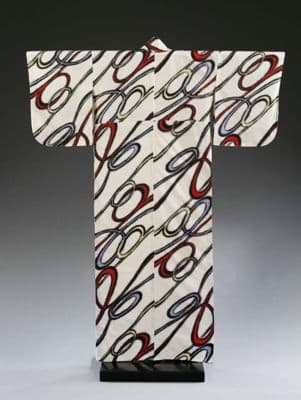
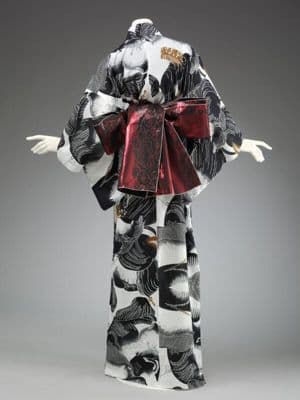
A contemporary yukata featuring bold black brushstroke motifs scattered across white cotton fabric, tied with a deep burgundy obi sash. The garment maintains traditional kimono construction with wide rectangular sleeves, straight seams, and wrap-front closure. The stencil-dyed pattern creates dynamic circular and curved forms reminiscent of calligraphy or abstract natural elements. The cotton fabric appears lightweight and suitable for summer wear, while the modern artistic interpretation of traditional motifs reflects contemporary Japanese design sensibilities blending heritage techniques with contemporary aesthetics.


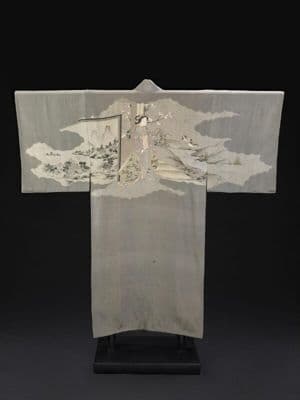
These two garments reveal how Japanese textile designers have long understood that the most powerful patterns whisper rather than shout. The contemporary yukata's bold black brushstrokes against white cotton echo the delicate landscape motifs scattered across the silk under-kimono's pale ground, both using negative space as deliberately as any mark.

Follow this garment wherever the graph leads
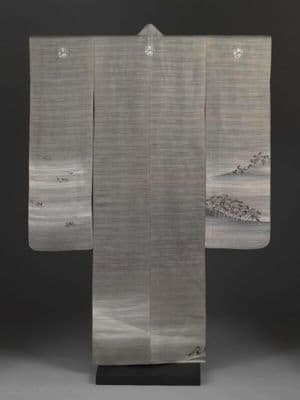
These two garments reveal how Japanese textile designers have long understood that the most powerful patterns whisper rather than shout. The contemporary yukata's bold black brushstrokes against white cotton echo the delicate landscape motifs scattered across the silk under-kimono's pale ground, both using negative space as deliberately as any mark.
These two summer kimono reveal how Japanese textile artists have long understood that negative space can be as powerful as bold gesture. The contemporary yukata's dramatic black brushstrokes against white cotton echo the Victorian-era ro kimono's misty landscape rendered in subtle gradations of gray silk gauze—both using restraint and asymmetry to create movement across the garment's broad canvas.
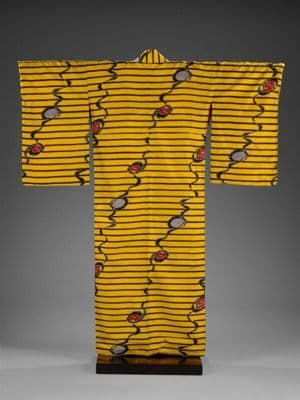
These two kimono reveal how Japanese textile artists have long used bold, gestural abstraction to energize the traditional T-shaped silhouette. The earlier piece deploys resist-dyeing to create meandering vertical chains against golden stripes—a rhythm that feels almost musical in its repetition—while the contemporary yukata uses dramatic black brushstrokes that sweep across white cotton like calligraphy gone wild.
These two kimono reveal how Japanese textile artists have long treated fabric as a canvas for gestural expression, whether through the Depression-era meisen silk's flowing calligraphic loops in burgundy and black or the contemporary yukata's bold, ink-wash brushstrokes that splash across white cotton like spilled sumi.

These two summer kimono reveal how Japanese textile artists have long understood that negative space can be as powerful as bold gesture. The contemporary yukata's dramatic black brushstrokes against white cotton echo the Victorian-era ro kimono's misty landscape rendered in subtle gradations of gray silk gauze—both using restraint and asymmetry to create movement across the garment's broad canvas.