V&A
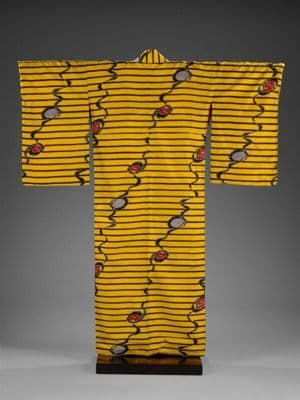
Resist-Dyed Cotton Kimono with Abstract Motif
Great Depression · 1930s · Japanese
Production
handmade
Material
resist-dyed cotton
Culture
Japanese
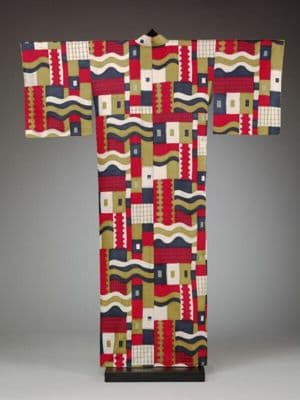
A traditional Japanese kimono constructed from rectangular cotton panels with wide, flowing sleeves and a straight-line silhouette. The garment features a vibrant golden yellow base with an abstract geometric pattern created through resist-dyeing technique. The design consists of vertical wavy lines in black with small circular motifs in red and brown scattered throughout. The pattern repeats consistently across all panels, creating visual continuity. The kimono displays the characteristic T-shaped construction with wide sleeves that extend horizontally, typical of traditional Japanese garment construction. The resist-dyeing creates crisp, defined edges between colors, demonstrating skilled textile craftsmanship of the Shōwa period.
dressstraightfloor length
Connected To
Worn with·obiWorn with·undergarmentsTechnique·resist-dyeingMotif·abstract-organic
SHARED80 years
These two kimonos reveal how Japanese textile artists navigated economic upheaval through ingenious pattern-making. The earlier Depression-era piece transforms humble cotton into visual richness with its undulating chains of circles against bold yellow stripes—resist-dyeing stretched to maximum impact when silk was unaffordable.
Text77%
Image
Worn with·obiWorn with·undergarmentsTechnique·resist-dyeingMotif·abstract-organic
Worn with·obiTechnique·resist-dyeingMotif·abstract-organic
SHARED80 years
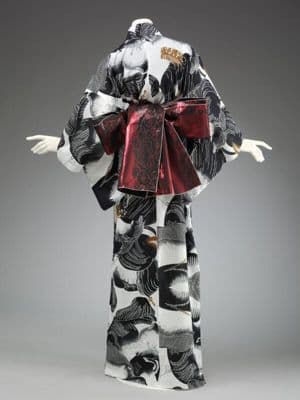
These two kimono reveal how Japanese textile artists have long used bold, gestural abstraction to energize the traditional T-shaped silhouette. The earlier piece deploys resist-dyeing to create meandering vertical chains against golden stripes—a rhythm that feels almost musical in its repetition—while the contemporary yukata uses dramatic black brushstrokes that sweep across white cotton like calligraphy gone wild.
Worn with·obiWorn with·undergarments
SHARED80 years
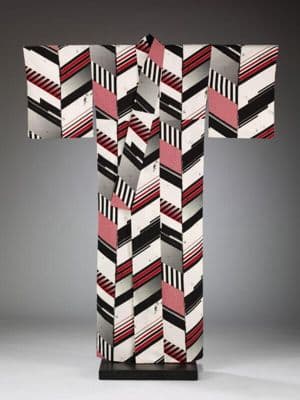
The geometric arrows slicing across the first kimono's coral and black field speak the same visual language as the chain-like motifs snaking down the yellow cotton of the second, both employing bold, repeating patterns that break from traditional Japanese florals.
Echoes Across Time
Japanese Traditional → Great Depression · 80yr65%
SHARED
These two kimonos reveal how Japanese textile artists navigated economic upheaval through ingenious pattern-making. The earlier Depression-era piece transforms humble cotton into visual richness with its undulating chains of circles against bold yellow stripes—resist-dyeing stretched to maximum impact when silk was unaffordable.
Worn with·obiWorn with·undergarmentsTechnique·resist-dyeing
Pull the Thread→
Follow this garment wherever the graph leads