V&A
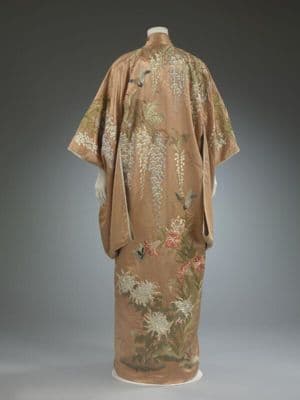
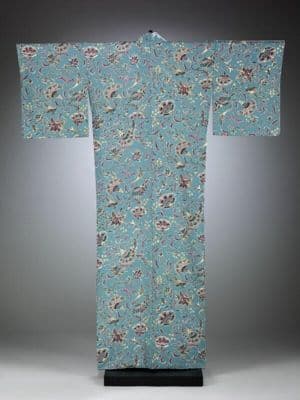
Stencil Dyed Hand-Painted Silk Kimono
2010s · 2010s · Japanese
Designer
Futaba-en
Production
artisan-craft
Material
silk
Culture
Japanese
Movement
Dark Academia
Influences
Edo period meisen technique · traditional Japanese floral symbolism
A formal Japanese kimono constructed in traditional T-shaped silhouette with wide, straight sleeves extending horizontally from the body. The garment displays meisen-style resist-dyed silk in turquoise blue ground decorated with scattered floral motifs in coral, pink, white, and green. Small chrysanthemum and cherry blossom patterns are distributed across the surface in an asymmetrical arrangement typical of contemporary kimono design. The fabric shows the characteristic slight sheen of silk with crisp edges and precise geometric construction. Traditional kimono proportions are maintained with floor-length hem and wide sleeve openings, representing continuity of Japanese textile traditions adapted for modern formal wear.
dressstraightfloor length
Connected To
Worn with·obiWorn with·undergarmentsTechnique·resist-dyeing
Echoes Across Time
2010s → Victorian Early / Crinoline · 170yr61%
SHARED
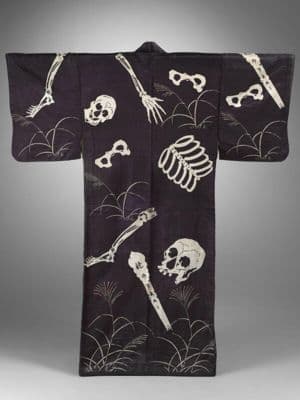
The turquoise kimono's delicate scattered florals and the black kosode's stark skulls and bones represent opposite poles of Japanese textile storytelling—one celebrating life's ephemeral beauty, the other confronting its inevitable end. Both use the same resist-dyeing technique to create their patterns, but where the earlier piece employs memento mori imagery with almost punk-rock boldness against its cotton ground, the contemporary silk version retreats into safe prettiness.
Worn with·obiWorn with·undergarmentsTechnique·resist-dyeing
Pull the Thread→
Follow this garment wherever the graph leads