Elizabethan · 1980s · British
Production
haute couture
Material
silk satin
Culture
British
Influences
18th century court dress · British royal regalia
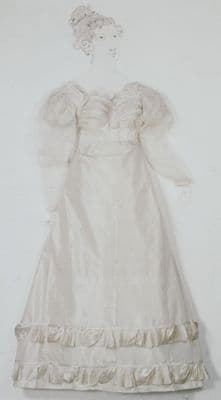
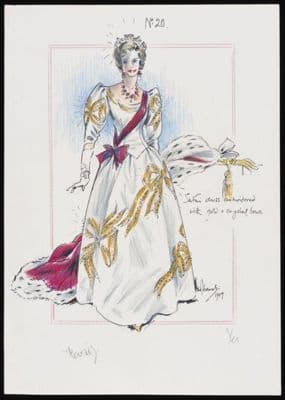
This fashion illustration depicts a formal court gown with an ivory silk satin base featuring burgundy and gold decorative elements. The design shows a fitted bodice with puffed sleeves and a dramatically full skirt that extends into a long train. Gold embellishments appear as ornamental details across the bodice and skirt. A burgundy sash crosses diagonally from shoulder to waist. The figure wears what appears to be a small crown or tiara, suggesting royal or ceremonial context. The illustration style is characteristic of 1980s fashion design sketches, with confident line work and watercolor-like color application. The garment's construction suggests traditional court dress conventions updated with 1980s proportions and styling sensibilities.


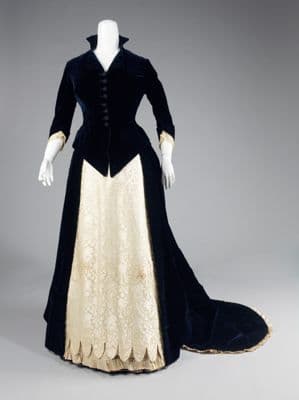
The Victorian bustle gown and Elizabethan court dress share the same aristocratic DNA: both use elaborate trains and fitted bodices to transform the female body into a display of wealth and status. Where the Elizabethan gown spreads horizontally with its wide skirts and ermine-trimmed train, the Victorian version channels that same imperial energy vertically through its cascading bustle silhouette, both demanding physical space as a form of social power.
Follow this garment wherever the graph leads
The Victorian bustle gown and Elizabethan court dress share the same aristocratic DNA: both use elaborate trains and fitted bodices to transform the female body into a display of wealth and status. Where the Elizabethan gown spreads horizontally with its wide skirts and ermine-trimmed train, the Victorian version channels that same imperial energy vertically through its cascading bustle silhouette, both demanding physical space as a form of social power.
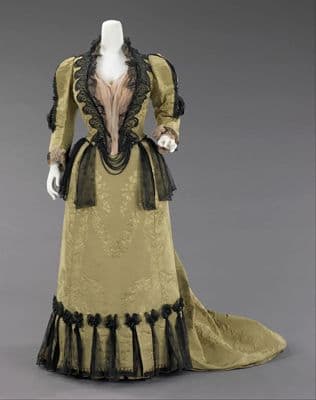
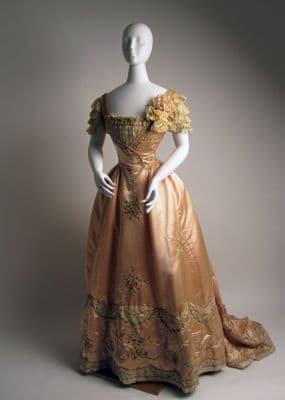
The bronze taffeta gown's cascading silk roses at the shoulder and the court dress's elaborate gold embroidery both speak the same language of conspicuous craft—each bloom and thread a small fortune made visible. Separated by nearly a century, they share an understanding that formal power dresses through accumulation: the Victorian gown piles on metallic trim and sculptural flowers while the earlier court dress layers ermine, jeweled orders, and that impossible train.
These two court gowns, separated by three centuries, reveal how power dressing transcends time through sheer architectural ambition. The Victorian bustle dress achieves its commanding presence through that dramatic navy velvet train and the rigid geometry of its fitted bodice, while the Elizabethan court gown deploys an equally theatrical arsenal—those puffed sleeves, the stiff brocaded bodice, and that impossibly wide skirt that forces everyone else to step aside.
These two gowns speak the same language of ceremonial whiteness, but with centuries of evolution between them. The Regency wedding dress whispers its formality through delicate puffed sleeves and precise satin trim at the hem, while the Elizabethan court gown roars its importance with sweeping burgundy sash and ermine-trimmed train.


The bronze taffeta gown's cascading silk roses at the shoulder and the court dress's elaborate gold embroidery both speak the same language of conspicuous craft—each bloom and thread a small fortune made visible. Separated by nearly a century, they share an understanding that formal power dresses through accumulation: the Victorian gown piles on metallic trim and sculptural flowers while the earlier court dress layers ermine, jeweled orders, and that impossible train.