THE MET
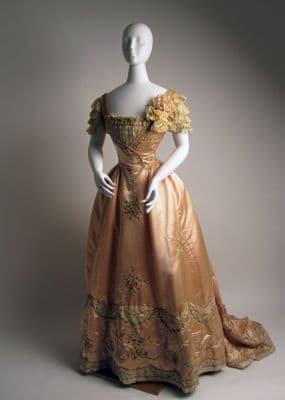
Golden Bronze Silk Taffeta Bustle Evening Gown
Fin de Siecle / Gibson Girl · 1890s · European
Production
haute couture
Material
silk taffeta
Culture
European
Movement
Aesthetic Movement
Influences
1890s S-curve silhouette · Victorian floral naturalism
This formal evening gown exemplifies late Victorian elegance with its characteristic silhouette of the 1890s. The bodice features a straight-across neckline with off-shoulder construction, adorned with elaborate three-dimensional floral appliqués in cream and golden tones that cascade asymmetrically across the bust. The fitted bodice emphasizes the corseted waist typical of the era. The skirt extends into a full train, constructed from lustrous silk taffeta in warm bronze tones. Decorative bands of contrasting trim create horizontal emphasis near the hem, while the fabric's crisp hand allows the skirt to maintain its sculptural bell shape. The overall construction demonstrates the period's preference for opulent surface decoration and dramatic formal silhouettes.
dressfit and flareoff-the-shoulderfloor length
Connected To
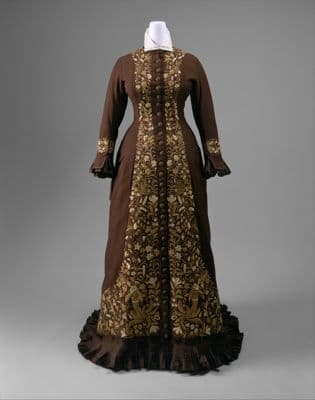
Worn with·bustle padWorn with·chemiseWorn with·corset
Echoes Across Time
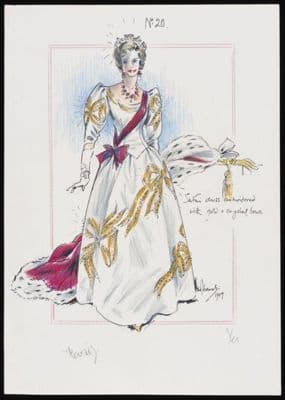
Fin de Siecle / Gibson Girl → Elizabethan · 90yr58%
SHARED
The bronze taffeta gown's cascading silk roses at the shoulder and the court dress's elaborate gold embroidery both speak the same language of conspicuous craft—each bloom and thread a small fortune made visible. Separated by nearly a century, they share an understanding that formal power dresses through accumulation: the Victorian gown piles on metallic trim and sculptural flowers while the earlier court dress layers ermine, jeweled orders, and that impossible train.
Worn with·corsetTechnique·couture-constructionTechnique·hand-embroidery
Pull the Thread→
Follow this garment wherever the graph leads