Empire / Regency · 1800s · British
Production
handmade
Material
silk satin
Culture
British
Influences
neoclassical Greek chiton · French Empire court dress
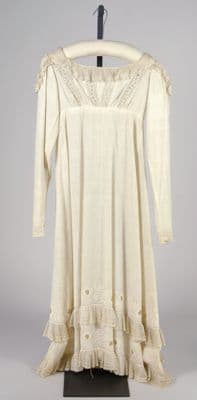
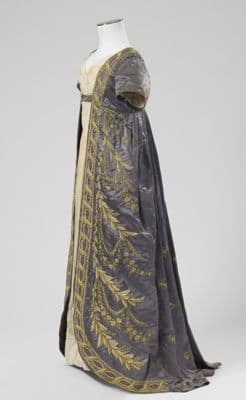
This empire waist gown features a high-waisted silhouette characteristic of the early 1800s, with a fitted bodice that sits just below the bust and flows into a long, straight skirt. The deep purple silk satin base is richly decorated with elaborate golden yellow embroidered or woven botanical motifs that cascade down the front and sleeves. The short, puffed sleeves are gathered at the shoulder and trimmed with the same golden decoration. The neckline is square-cut and modest. The skirt falls in straight, columnar lines to the floor with a slight train, embodying the neoclassical aesthetic that defined Regency fashion. The luxurious silk satin has a lustrous surface that would have caught candlelight beautifully in evening settings.


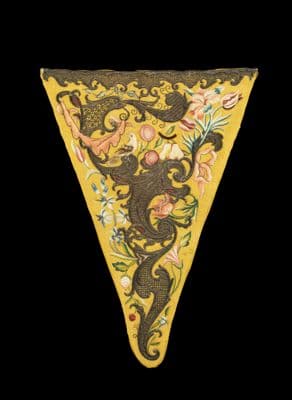
These two pieces trace the evolution of ornamental excess from Rococo abundance to neoclassical restraint. The stomacher's riot of embroidered florals—those twisting vines and blooms that would have blazed against a silk gown—represents the last gasp of 18th-century decorative maximalism, while the Empire dress channels that same golden embroidery into disciplined neoclassical borders that frame rather than overwhelm the body.
Follow this garment wherever the graph leads
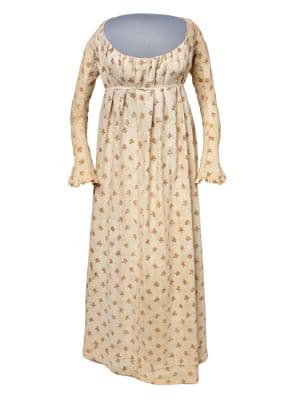
These two gowns reveal how the Empire silhouette could swing from morning simplicity to evening grandeur while maintaining its essential DNA. The cream muslin dress whispers with its delicate whitework embroidery and modest cotton, embodying the Regency ideal of studied simplicity, while the purple silk blazes with metallic gold embroidery that transforms the same high-waisted template into something fit for a court presentation.
These two gowns reveal how the same neoclassical revolution played out across different social strata: the purple silk satin with its golden botanical embroidery speaks to British court formality, while the cream cotton with its tiny scattered motifs whispers of American domesticity.
These two pieces trace the evolution of ornamental excess from Rococo abundance to neoclassical restraint. The stomacher's riot of embroidered florals—those twisting vines and blooms that would have blazed against a silk gown—represents the last gasp of 18th-century decorative maximalism, while the Empire dress channels that same golden embroidery into disciplined neoclassical borders that frame rather than overwhelm the body.
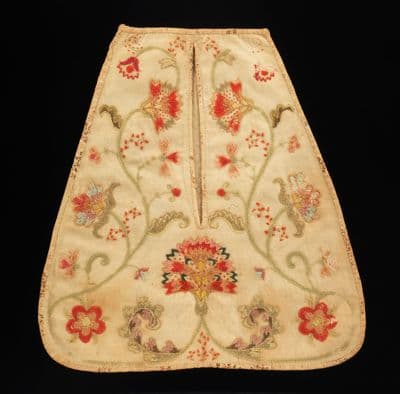
The golden scrollwork embroidered across this Empire gown's purple silk and the riot of coral blooms dancing across the linen pocket speak the same decorative language, separated by just fifty years but worlds apart in purpose. Where the Rococo pocket—a woman's private universe of trinkets and coins—revels in asymmetrical botanical abundance, the Empire dress disciplines that same floral impulse into neoclassical order, its gold vines marching in stately procession down the trained silk.


The golden scrollwork embroidered across this Empire gown's purple silk and the riot of coral blooms dancing across the linen pocket speak the same decorative language, separated by just fifty years but worlds apart in purpose. Where the Rococo pocket—a woman's private universe of trinkets and coins—revels in asymmetrical botanical abundance, the Empire dress disciplines that same floral impulse into neoclassical order, its gold vines marching in stately procession down the trained silk.