Empire / Regency · 1800s · American
Production
handmade
Material
cotton
Culture
American
Influences
neoclassical Greek chiton · Directoire simplicity
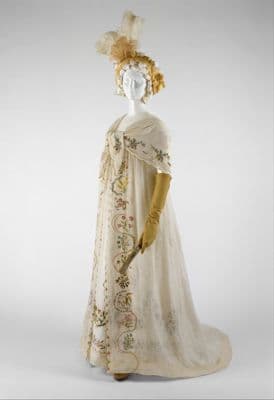
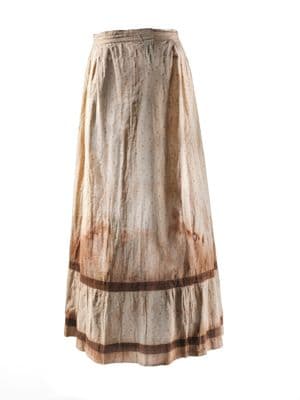
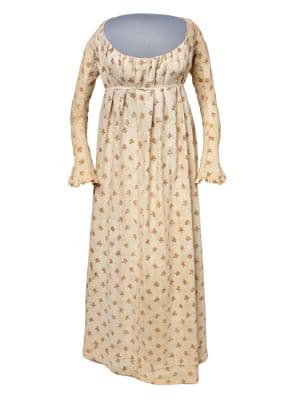
This cotton day dress exemplifies Empire period construction with its characteristic high waistline positioned just below the bust. The bodice features a square neckline with gathered fabric creating soft volume across the chest. Long fitted sleeves extend to the wrists with gathered cuffs. The skirt falls in straight, columnar lines from the empire waist to floor length, embodying the neoclassical silhouette that rejected the structured corseted forms of the 18th century. The fabric displays a small-scale repeating floral or geometric motif in golden yellow on cream ground, typical of early 19th-century cotton prints. The overall construction emphasizes natural body lines and comfortable movement, reflecting the period's embrace of classical Greek and Roman aesthetic ideals in women's dress.
Follow this garment wherever the graph leads
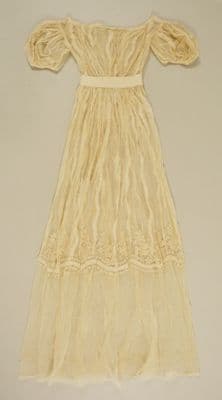
Both dresses spring from the same revolutionary moment when fashion threw off the corset and reached back to antiquity for inspiration, but they landed in different worlds. The French gown, with its museum-perfect white muslin and delicate embroidered trim, embodies the pure neoclassical ideal that swept through post-Revolutionary Paris—all flowing lines and Grecian simplicity.
These two gowns reveal how Empire style's neoclassical ideal traveled from silk drawing rooms to cotton everyday life. The wedding dress's lustrous muslin and delicate lace trim speak to formal aspirations, while the day dress's printed cotton and practical long sleeves show how the same high-waisted, columnar silhouette adapted for daily wear.
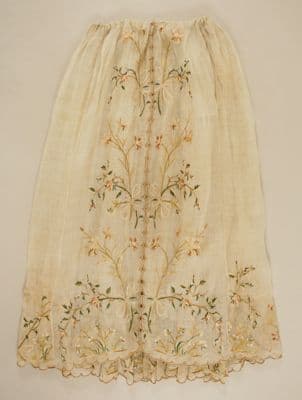
These two garments reveal how the neoclassical revival swept across both sides of the Atlantic, translating ancient Greek ideals into early 19th-century wardrobes. The French silk skirt, with its delicate gold embroidery climbing like vines from hem to waist, represents the luxury version of Empire style—meant to be worn over a fine chemise as part of a layered ensemble.
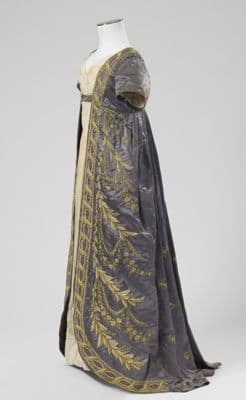
These two gowns reveal how the same neoclassical revolution played out across different social strata: the purple silk satin with its golden botanical embroidery speaks to British court formality, while the cream cotton with its tiny scattered motifs whispers of American domesticity.