Neoclassical Transition · 1780s · British
Production
handmade
Material
silk satin striped plain weave
Culture
British
Influences
French court fashion · English country gentleman style
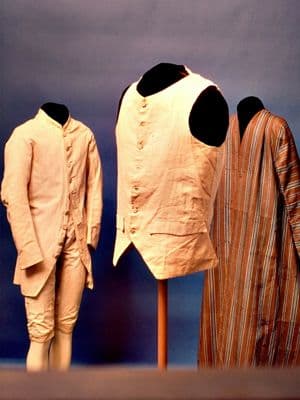
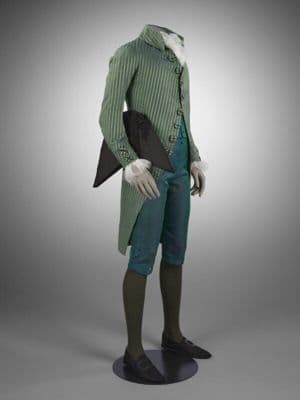
This gentleman's coat displays the transitional silhouette of the 1780s, featuring a fitted bodice that extends into moderately flared skirts reaching mid-thigh. The coat is constructed from silk with alternating vertical stripes in sage green and teal blue on a cream ground. The front edges curve away from center, revealing the waistcoat beneath, while the standing collar shows period-appropriate height. Matching covered buttons run down the front closure. The sleeves are fitted through the arm with turned-back cuffs. The coat's proportions reflect the movement away from the extremely wide skirts of mid-century toward the more streamlined silhouettes that would define the 1790s, while maintaining the formal structure expected of gentleman's dress.


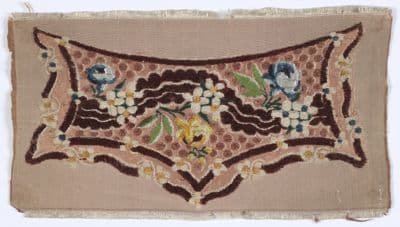
That baroque waistcoat pocket's riot of silk-embroidered flowers and serpentine vines speaks the same decorative language as the neoclassical coat's green satin stripes, just translated through different centuries of masculine restraint.

Follow this garment wherever the graph leads
These two coats capture the exact moment when men's fashion pivoted from Rococo excess to Neoclassical restraint. Sheldon's buff-colored cotton suit, with its clean lines and practical American sensibility, strips away the ornamental fuss that still clings to the British silk coat's elaborate striped weave and decorative trim.
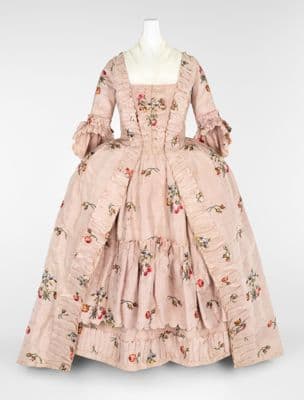
The pink robe's scattered floral sprigs and that green coat's precise vertical stripes represent two sides of the same 18th-century obsession with surface decoration, but they're marking opposite poles of taste. Where the earlier robe blooms with rococo's love of natural motifs scattered like confetti across silk taffeta, the later coat disciplines that decorative impulse into neoclassical geometry—those crisp green satin stripes running down blue silk like architectural columns.
That baroque waistcoat pocket's riot of silk-embroidered flowers and serpentine vines speaks the same decorative language as the neoclassical coat's green satin stripes, just translated through different centuries of masculine restraint.
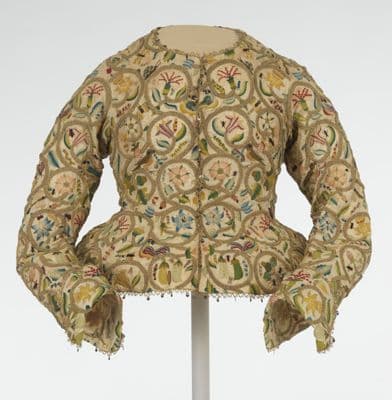
That Jacobean waistcoat's riot of embroidered flowers and vines speaks the same ornamental language as the striped coat's precise green satin bands—both are about surface decoration as social signaling, though separated by 170 years and a revolution in taste. The earlier piece broadcasts wealth through labor-intensive needlework that covers every inch, while the later coat achieves the same effect through the subtle luxury of woven stripes that catch light with each movement.

That Jacobean waistcoat's riot of embroidered flowers and vines speaks the same ornamental language as the striped coat's precise green satin bands—both are about surface decoration as social signaling, though separated by 170 years and a revolution in taste. The earlier piece broadcasts wealth through labor-intensive needlework that covers every inch, while the later coat achieves the same effect through the subtle luxury of woven stripes that catch light with each movement.