Jacobean · 1610s · British
Production
handmade
Material
silk embroidered linen
Culture
British
Influences
Tudor blackwork tradition · Continental embroidery patterns
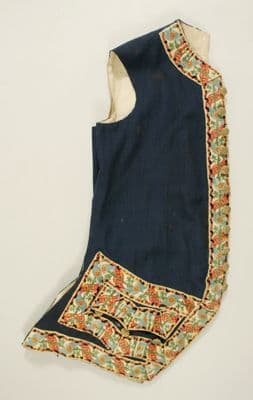
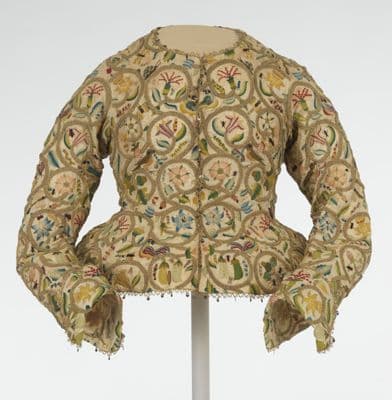
This Jacobean waistcoat displays the characteristic fitted silhouette of early 17th-century men's formal wear, with a high neckline and closely tailored body that would have been worn over a shirt and under a doublet or jerkin. The cream linen ground is entirely covered with silk embroidery in a repeating pattern of circular medallions containing stylized floral motifs including roses and carnations. The embroidery work shows dense coverage with chain stitch and satin stitch techniques creating raised texture across the surface. Long fitted sleeves extend to pointed cuffs with scalloped edges, and the waistcoat appears to have a center front opening. The sophisticated needlework and expensive materials indicate this was made for a wealthy gentleman of the Jacobean court.


That olive Jacobean jacket and the navy livery waistcoat are separated by two centuries but united by the same aristocratic impulse: using embroidered ornament to broadcast status through sheer labor costs. The earlier piece drowns its wearer in a garden of silk threads worked into every available surface, while the later waistcoat deploys its floral borders more strategically, framing the body rather than consuming it.
Follow this garment wherever the graph leads
That olive Jacobean jacket and the navy livery waistcoat are separated by two centuries but united by the same aristocratic impulse: using embroidered ornament to broadcast status through sheer labor costs. The earlier piece drowns its wearer in a garden of silk threads worked into every available surface, while the later waistcoat deploys its floral borders more strategically, framing the body rather than consuming it.
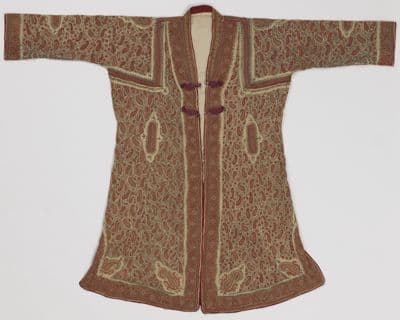
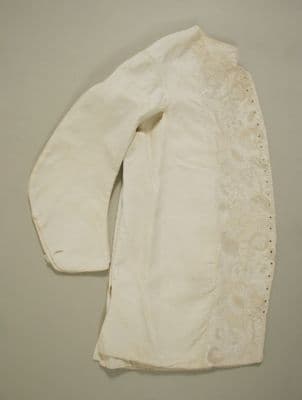
The olive waistcoat's riot of crewelwork flowers and vines speaks the same decorative language as the cream waistcoat's delicate whitework embroidery, but with 130 years between them, you're watching English men's fashion move from baroque abundance to rococo restraint. Where the earlier piece demands attention with its polychrome garden of silk threads sprawling across every surface, the later waistcoat whispers its luxury through subtle tone-on-tone florals that catch light rather than color.
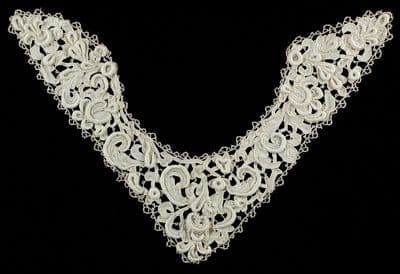
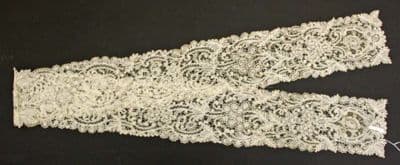
These pieces reveal how the same aristocratic impulse for botanical ornament traveled from Italian collar to English waistcoat across three decades of shifting court fashion.
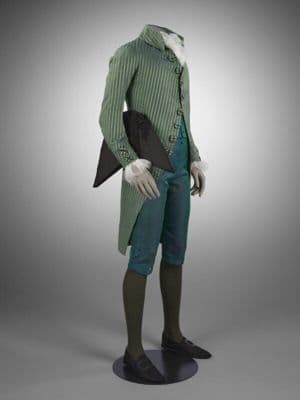
That Jacobean waistcoat's riot of embroidered flowers and vines speaks the same ornamental language as the striped coat's precise green satin bands—both are about surface decoration as social signaling, though separated by 170 years and a revolution in taste. The earlier piece broadcasts wealth through labor-intensive needlework that covers every inch, while the later coat achieves the same effect through the subtle luxury of woven stripes that catch light with each movement.


The olive waistcoat's riot of crewelwork flowers and vines speaks the same decorative language as the cream waistcoat's delicate whitework embroidery, but with 130 years between them, you're watching English men's fashion move from baroque abundance to rococo restraint. Where the earlier piece demands attention with its polychrome garden of silk threads sprawling across every surface, the later waistcoat whispers its luxury through subtle tone-on-tone florals that catch light rather than color.