THE MET
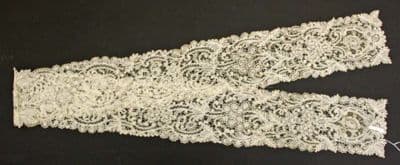
Cream Belgian Bobbin Lace Scarf
Victorian Late / Bustle · 1880s · Belgian
Production
handmade
Material
bobbin lace
Culture
Belgian
Influences
Flemish bobbin lace tradition
This Belgian bobbin lace scarf displays the intricate geometric and floral motifs characteristic of late 19th-century European lacemaking. The piece features a repeating pattern of circular medallions connected by delicate mesh ground, with scalloped edges that create rhythmic undulations along both borders. The lace construction shows fine thread work with varying densities - denser floral elements contrasting against open mesh areas. The linear format and substantial width suggest it was designed to drape around the shoulders or neck as formal evening wear, complementing the elaborate dress silhouettes of the Victorian bustle period.
scarf
Connected To
Influences·Flemish bobbin lace traditionTechnique·laceworkFunction·court-formal
SHARED140 years · cross-culture · cross-category
These two pieces trace the elegant persistence of Flemish bobbin lace technique across nearly 150 years, from rococo court ritual to Victorian bourgeois display. The earlier lappet's architectural precision—those crisp geometric medallions and structured drape designed to frame an 18th-century powdered coiffure—gives way to the scarf's more organic floral sprawl, its softer motifs meant to cascade over a bustle-era silhouette.
Text78%
Image88%
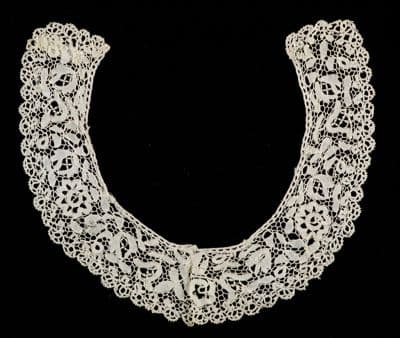
Influences·Flemish bobbin lace tradition
SHAREDsame era · cross-culture
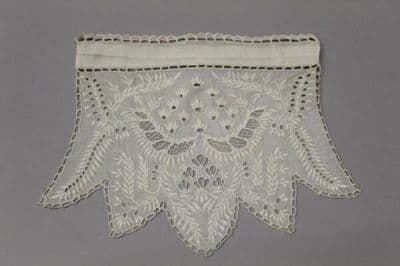
Both pieces emerge from the same Victorian obsession with Flemish bobbin lace, but their forms reveal different social ambitions. The collar's dense, architectural scrollwork was designed to frame a face with bourgeois propriety—notice how the pattern radiates outward like a textile halo, transforming any plain dress into something respectable.
Text
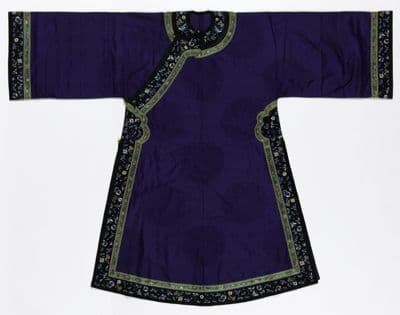
Technique·hand-weavingFunction·court-formal
SHARED80 years · cross-culture · cross-category
Text53%
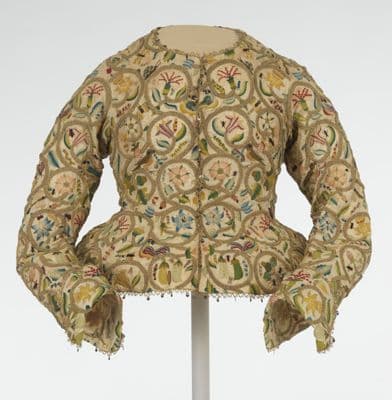
Function·court-formalMotif·medallion
SHARED270 years · cross-culture · cross-category
Text58%
Echoes Across Time
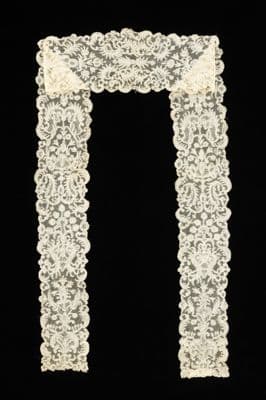
Rococo → Victorian Late / Bustle · 140yr70%
SHARED
These two pieces trace the elegant persistence of Flemish bobbin lace technique across nearly 150 years, from rococo court ritual to Victorian bourgeois display. The earlier lappet's architectural precision—those crisp geometric medallions and structured drape designed to frame an 18th-century powdered coiffure—gives way to the scarf's more organic floral sprawl, its softer motifs meant to cascade over a bustle-era silhouette.
Influences·Flemish bobbin lace traditionTechnique·laceworkFunction·court-formal
Pull the Thread→
Follow this garment wherever the graph leads