THE MET
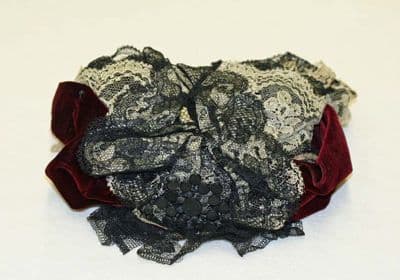
Black Silk Lace Victorian Mourning Bonnet
Victorian Late / Bustle · 1870s · American
Production
ready-to-wear
Material
silk lace
Culture
American
Influences
Victorian mourning dress codes
A Victorian mourning bonnet constructed from delicate black silk lace with intricate floral patterns. The bonnet features a close-fitting crown that would sit snugly on the head, with deep burgundy velvet ribbon ties that would secure under the chin. The black lace appears to be machine-made with a fine mesh ground supporting elaborate rose and leaf motifs. The bonnet's interior shows cream-colored silk lining. The construction demonstrates typical 1870s millinery techniques with the lace carefully gathered and shaped over a buckram foundation. The burgundy ribbon provides the only color accent against the somber black lace, following mourning dress conventions of the period.
hat
Connected To
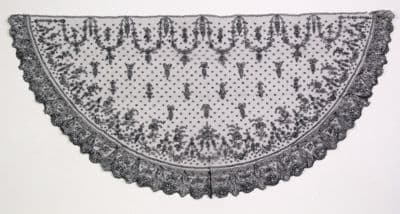
Worn with·mourning dressTechnique·laceworkFunction·mourning
SHARED30 years · cross-culture · cross-category
Both pieces deploy the same visual grammar of grief: black silk lace worked into delicate patterns that seem to mock their somber purpose, creating beauty from bereavement. The veil's sweeping semicircle would have draped a widow's entire silhouette in its intricate web, while thirty years later the bonnet concentrates that same lace language into a more contained statement, its ruffled architecture framing the face with deliberate drama.
Text89%
Image74%
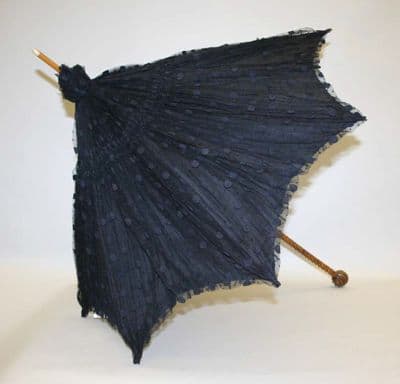
Worn with·mourning dressTechnique·laceworkFunction·mourning
SHAREDsame era · cross-culture · cross-category
These two mourning accessories reveal how Victorian grief demanded its own elaborate visual vocabulary, even in the smallest details. The parasol's densely pleated black lace creates dramatic shadows that would have flickered across a widow's dress as she moved, while the bonnet's more delicate lacework frames the face with calculated fragility—both using the transparency of lace not to reveal, but to create layers of concealment.
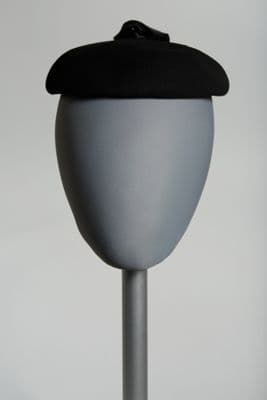
Worn with·mourning dressFunction·mourning
SHARED70 years
These two mourning caps trace the evolution of grief's uniform across seven decades, from the Victorian bonnet's elaborate lace cascade to the 1940s cap's stark felt dome. The earlier piece treats sorrow as spectacle—its black silk lace unfurls like baroque theater, demanding attention and reverence—while the wartime cap compresses mourning into a tight, practical skull that acknowledges loss without ceremony.
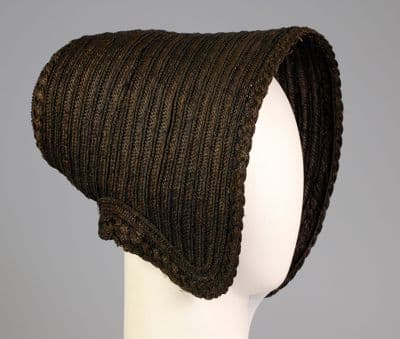
Worn with·mourning dressFunction·mourning
SHARED30 years
These two mourning bonnets trace the evolution of Victorian grief from stark Puritan discipline to ornate emotional theater. The earlier poke bonnet, with its severe black straw and deep tunnel brim, enforces the wearer's withdrawal from the world—a portable cave of mourning that blocks peripheral vision and social interaction.
Pull the Thread→
Follow this garment wherever the graph leads