THE MET
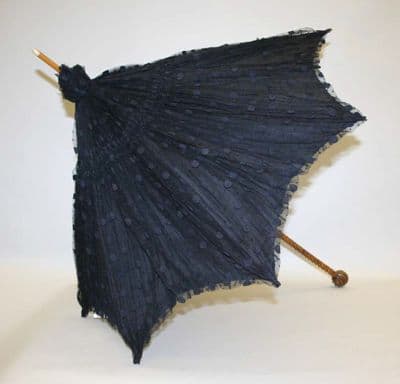
Black Lace Victorian Mourning Parasol
Victorian Late / Bustle · 1870s · American or European
Production
mass-produced
Material
black lace
Culture
American or European
Influences
Victorian mourning protocols
A Victorian mourning parasol featuring deep black lace stretched over a traditional parasol frame with wooden handle and ribs. The lace appears to be machine-made with a geometric pattern, showing the characteristic frayed and deteriorated edges common to aged textiles. The parasol construction follows the typical late 19th-century design with multiple wooden ribs radiating from a central hub, creating the classic dome shape when opened. The handle appears to be turned wood, likely bamboo or similar lightweight material. This type of black lace parasol was essential mourning attire for Victorian women, providing both sun protection and adherence to strict mourning dress codes that required all-black accessories for extended periods following bereavement.
umbrella
Connected To
Worn with·mourning bonnetWorn with·mourning dressTechnique·laceworkFunction·mourning
SHARED30 years · cross-culture · cross-category
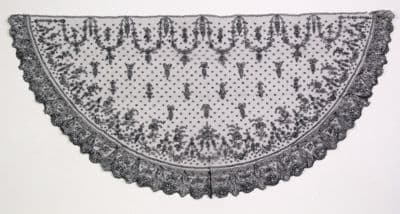
These two pieces reveal how Victorian mourning culture transformed grief into an entire aesthetic universe, where every accessory had to whisper loss in precisely the right register. The semicircular veil's intricate floral lace pattern creates a delicate screen between the wearer and the world, while the parasol's deep scalloped edge and radiating pleats turn protection from sunlight into a statement of perpetual shadow.
Text82%
Worn with·mourning bonnetWorn with·mourning dressFunction·mourning
SHARED20 years · cross-culture · cross-category
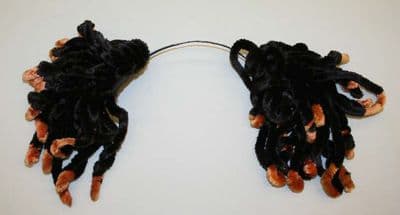
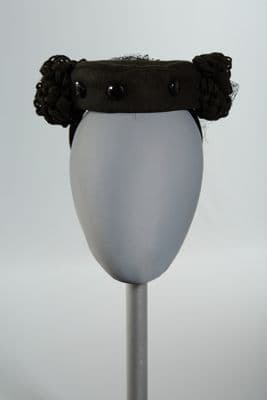
These two mourning accessories reveal how Victorian grief culture evolved from theatrical display to subtle sophistication. The earlier headdress, with its wild cascade of black silk tassels tipped in amber beads, announces loss with an almost primitive intensity—those unruly strands would have trembled with every movement, making mourning impossible to ignore.
Worn with·mourning dressTechnique·laceworkFunction·mourning
SHARED10 years · cross-culture · cross-category
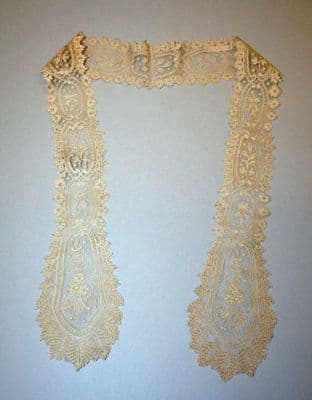
The mourning parasol's dense black lace creates an almost architectural canopy of grief, its intricate pattern designed to cast shadows as deliberate as the widow's social withdrawal, while the cream collar's delicate bobbin work traces paisley teardrops that would have framed a face already marked by loss.
Worn with·mourning dressTechnique·laceworkFunction·mourning
SHAREDsame era · cross-culture · cross-category
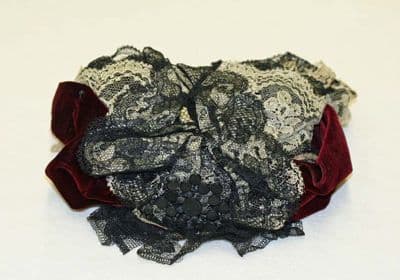
These two mourning accessories reveal how Victorian grief demanded its own elaborate visual vocabulary, even in the smallest details. The parasol's densely pleated black lace creates dramatic shadows that would have flickered across a widow's dress as she moved, while the bonnet's more delicate lacework frames the face with calculated fragility—both using the transparency of lace not to reveal, but to create layers of concealment.
Pull the Thread→
Follow this garment wherever the graph leads