Fin de Siecle / Gibson Girl · 1900s · American
Production
handmade
Material
silk brocade
Culture
American
Movement
Art Nouveau
Influences
Victorian fitted bodice · Art Nouveau floral motifs
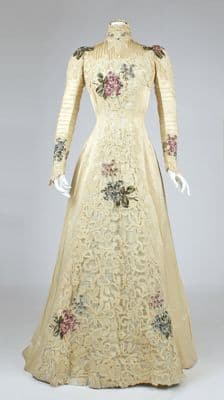
This formal gown features a high-necked fitted bodice with long sleeves and elaborate floral brocade patterning throughout the cream-colored silk fabric. The dress displays scattered rose motifs in mauve and pink with green foliage against the pale ground. The bodice is closely fitted through the torso and waist, typical of the period's corseted silhouette. The skirt extends to floor length with a subtle flare, creating an elegant A-line shape. Decorative trim appears at the shoulder seams and cuffs, likely in a contrasting metallic or darker tone. The high neckline and long sleeves indicate formal evening or reception wear, reflecting the modest yet luxurious aesthetic of turn-of-the-century American fashion.


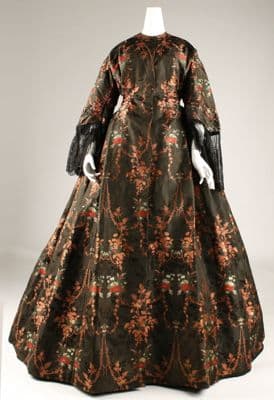
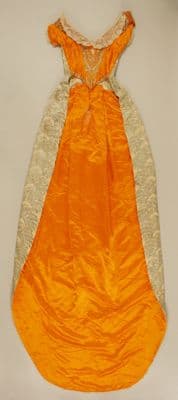
The chocolate brocade's dense floral weave and the cream gown's delicate rose sprigs represent the evolution of American formal dress from the 1870s bustle era to the 1900s Gibson Girl period — both cut from silk brocade but worlds apart in their relationship to the female form.

Follow this garment wherever the graph leads
The chocolate brocade's dense floral weave and the cream gown's delicate rose sprigs represent the evolution of American formal dress from the 1870s bustle era to the 1900s Gibson Girl period — both cut from silk brocade but worlds apart in their relationship to the female form.
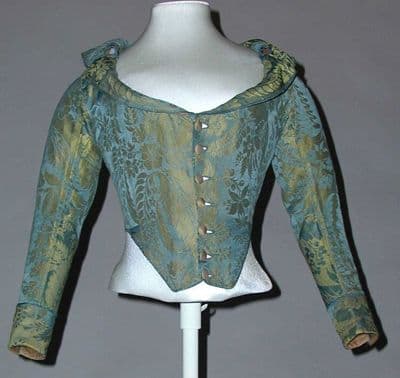
Both garments speak the same language of silk brocade luxury, but with a century's worth of evolution in how women wanted to inhabit their bodies. The 18th-century caraco's jade-green silk wraps the torso like armor—that rigid button front and fitted bodice designed to showcase the engineering of stays beneath—while the Edwardian tea gown flows in buttery cream silk that whispers of liberation, its high neck and fluid A-line suggesting a woman who could actually breathe.
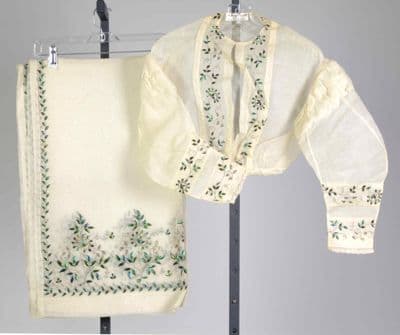
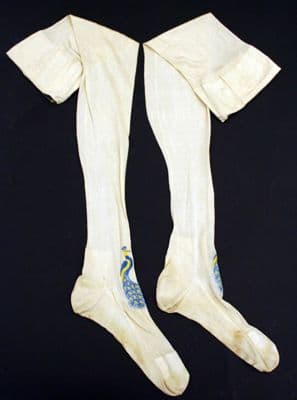
These cream silk pieces reveal how Victorian formality infiltrated every layer of dress, from the intimate to the ceremonial. The stockings, with their delicate blue floral embroidery climbing toward the knee, transformed an unseen undergarment into a work of art that matched the elaborate surface decoration of the later tea gown, where similar botanical motifs bloom across brocaded silk in a symphony of texture and pattern.
These pieces reveal how Victorian women's relationship with floral ornament evolved from earnest domesticity to theatrical sophistication. The cotton stole's neat border of green embroidered sprigs—likely worked by hand in a parlor—speaks to the mid-century cult of feminine accomplishment, where a lady's needlework proved her virtue.

Both garments speak the same language of silk brocade luxury, but with a century's worth of evolution in how women wanted to inhabit their bodies. The 18th-century caraco's jade-green silk wraps the torso like armor—that rigid button front and fitted bodice designed to showcase the engineering of stays beneath—while the Edwardian tea gown flows in buttery cream silk that whispers of liberation, its high neck and fluid A-line suggesting a woman who could actually breathe.