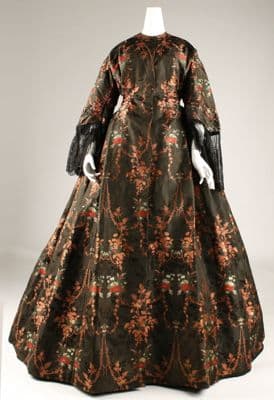
Victorian Late / Bustle · 1860s · American
Production
handmade
Material
silk brocade
Culture
American
Influences
French Second Empire fashion · bustle silhouette
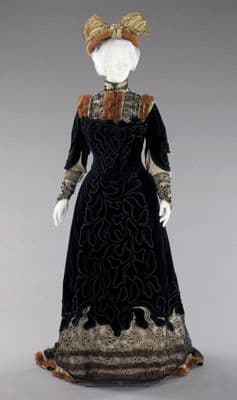
This Victorian bustle dress features a fitted bodice with long sleeves and a dramatically full skirt supported by an underlying bustle structure. The silk brocade displays an elaborate floral pattern with coral pink roses and green foliage against a rich dark brown ground. The fabric appears to have a lustrous finish typical of period silk brocades. The bodice fits closely through the torso with what appears to be a high neckline, while the skirt extends into a pronounced train. The construction demonstrates the period's emphasis on creating an exaggerated silhouette that emphasized the contrast between a tightly corseted waist and voluminous lower body. The luxurious brocaded silk and complex floral motifs indicate this was a high-status garment for formal daytime occasions.


The chocolate brocade's dense floral weave and the cream gown's delicate rose sprigs represent the evolution of American formal dress from the 1870s bustle era to the 1900s Gibson Girl period — both cut from silk brocade but worlds apart in their relationship to the female form.

Follow this garment wherever the graph leads
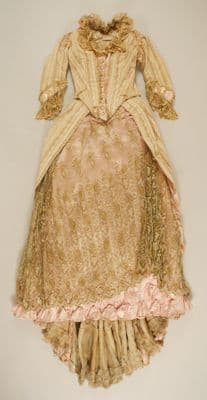
The brocade's cascading florals and the velvet's sinuous trim speak the same Victorian language of abundance, but with a crucial shift in accent. Where the earlier dress announces wealth through sheer surface area—that vast sweep of silk blooming with roses—the later ensemble concentrates its luxury into strategic gold embroidery that snakes along the bodice and hem like jewelry made permanent.
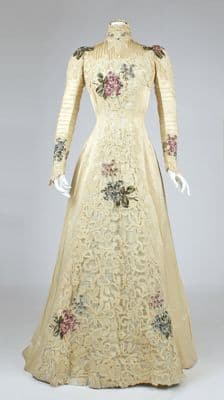
These two gowns bracket the great transformation of late Victorian silhouette—the first, with its severe dark brocade and architectural bustle projection, represents the rigid geometry of 1870s fashion, while the champagne confection shows how that same foundational corsetry evolved into the sinuous, lace-draped curves of Belle Époque elegance.
The chocolate brocade's dense floral weave and the cream gown's delicate rose sprigs represent the evolution of American formal dress from the 1870s bustle era to the 1900s Gibson Girl period — both cut from silk brocade but worlds apart in their relationship to the female form.
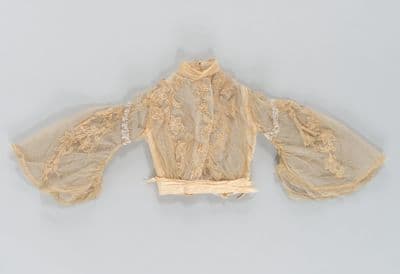
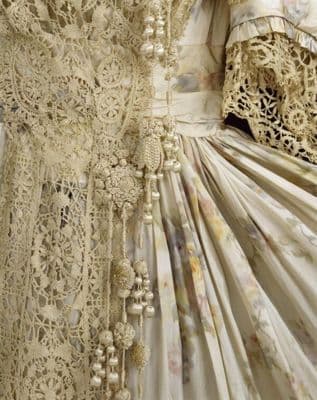
These two garments capture the Victorian obsession with surface ornament, but reveal how that impulse evolved from bold statement to whispered luxury. The dark brocade dress commands attention with its large-scale floral weaving—roses blooming dramatically across brown silk in a pattern that reads from across a room—while the cream bodice speaks in lace's more intimate language, its delicate appliqué creating texture you'd need to lean in to fully appreciate.

These two gowns reveal how Victorian excess gave way to Edwardian refinement through the language of surface decoration. The earlier brown brocade dress speaks in the heavy, almost masculine vocabulary of woven florals—roses and foliage that seem carved into the silk itself—while the cream Edwardian gown whispers with delicate printed posies scattered like confetti across its taffeta surface.