Belle Epoque · 1890s-1900s · French
Production
haute couture
Material
silk with lace overlay
Culture
French
Influences
1890s S-curve silhouette · French couture construction
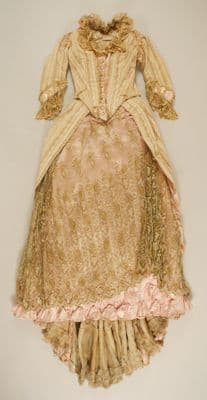
This Belle Époque dinner dress features a high-necked bodice with elaborate ruched silk trim creating textural waves around the neckline and extending down the front closure. The fitted bodice has long sleeves with gathered fullness at the shoulders, tapering to fitted cuffs. The skirt displays a complex layered construction with an overskirt of delicate lace featuring an all-over floral pattern, revealing glimpses of the underlying silk fabric. The hemline shows a decorative pink ruffle trim, while the back extends into a modest train typical of formal 1890s evening wear. The overall silhouette emphasizes the corseted waist and creates the characteristic S-curve profile of the period through structured undergarments.


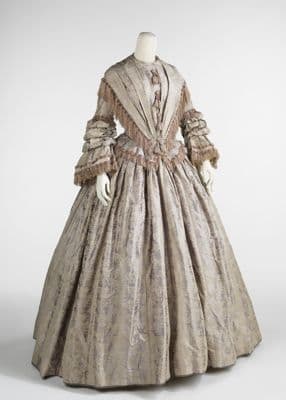
These two gowns trace the evolution of Victorian propriety from fortress to flirtation. The earlier gray brocade dress, with its severe high neckline and armor-like bodice construction, embodies mid-Victorian moral rectitude—every inch of skin locked away behind silk walls.

Follow this garment wherever the graph leads
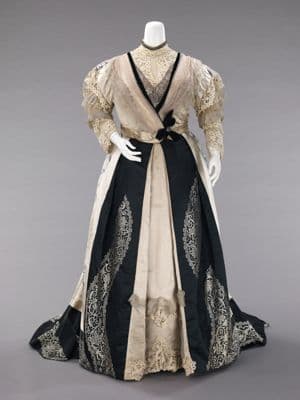
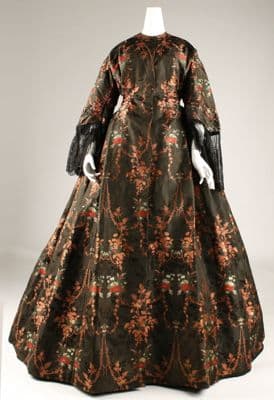
These two gowns bracket the great transformation of late Victorian silhouette—the first, with its severe dark brocade and architectural bustle projection, represents the rigid geometry of 1870s fashion, while the champagne confection shows how that same foundational corsetry evolved into the sinuous, lace-draped curves of Belle Époque elegance.
Both dresses deploy lace as architectural ornament, but where the Belle Époque gown uses it as a gossamer veil that softens the rigid corsetry beneath, the later Edwardian dress treats lace as strategic punctuation—those precise appliqués on the black silk panels read like calligraphy against the stark contrast.
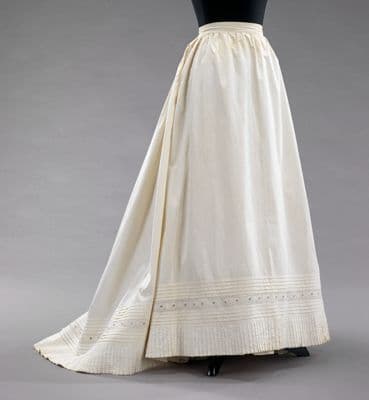
This champagne silk confection and its humble cotton underpinning reveal the Belle Époque's genius for layered seduction—one couldn't exist without the other. The petticoat's crisp pleated hem and delicate eyelet trim were designed to peek flirtatiously beneath that golden lace overlay, creating the era's signature silhouette where even underwear was a performance.
These two gowns trace the evolution of Victorian propriety from fortress to flirtation. The earlier gray brocade dress, with its severe high neckline and armor-like bodice construction, embodies mid-Victorian moral rectitude—every inch of skin locked away behind silk walls.