Victorian Late / Bustle · 1870s · American
Production
handmade
Material
silk taffeta
Culture
American
Influences
bustle pad construction · military-inspired trim
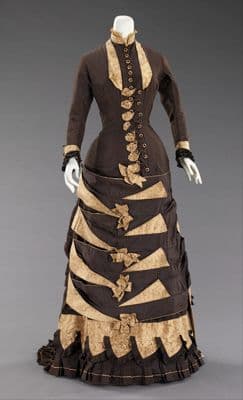
This 1879 American wedding dress exemplifies the Victorian bustle silhouette with its dramatically fitted bodice and elaborate skirt construction. The dark brown silk taffeta is trimmed with golden tan silk in geometric bands that spiral around the skirt in a distinctive diagonal pattern. The bodice features a high neckline with standing collar, long fitted sleeves with contrasting cuffs, and a center-front button closure extending down to the natural waist. The skirt displays the characteristic bustle projection with multiple horizontal bands of tan silk creating visual weight at the back hem. Decorative fringe trim edges the tan bands, adding textural interest. The overall construction demonstrates skilled dressmaking with precise seaming and professional finishing techniques typical of formal Victorian garments.


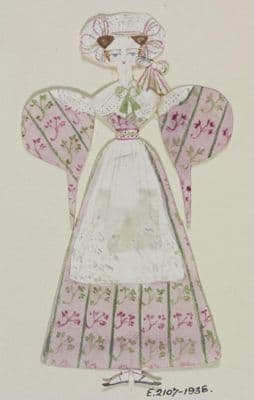
The chocolate-brown bustle dress with its diagonal bands of golden trim and the watercolor's pink-striped day dress with its crisp white apron share an obsession with horizontal interruption — both use repeating elements to break up the female form into manageable visual portions.

Follow this garment wherever the graph leads
The chocolate-brown bustle dress with its diagonal bands of golden trim and the watercolor's pink-striped day dress with its crisp white apron share an obsession with horizontal interruption — both use repeating elements to break up the female form into manageable visual portions.
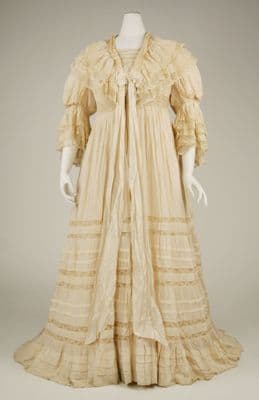
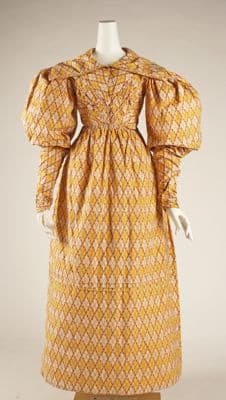
Both dresses worship at the altar of extreme sleeves, but where the Victorian bustle dress whispers its drama through brown silk's restrained elegance and architectural bows, the golden cotton confection fifty years later screams it through balloon sleeves so exaggerated they could house small children.
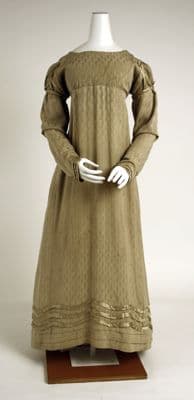
These two dresses trace the dramatic arc of 19th-century American women's fashion, from the high-waisted, columnar simplicity of the 1810s Empire dress to the elaborate architectural bustle silhouette of the 1870s.
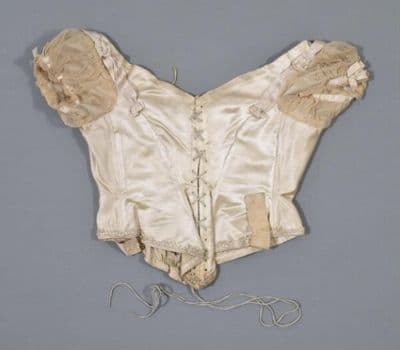
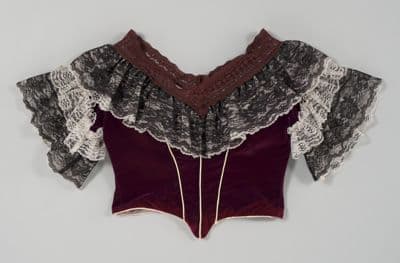
These two garments trace the evolution of Victorian structure and seduction across twenty years of radical silhouette change. The earlier cream bodice, with its off-shoulder bertha collar and front-lacing corset construction, belongs to the 1850s era when the ideal was a smooth bell shape created by crinolines—notice how the bodice hugs close to emphasize the contrast with the skirt's volume below.

Both dresses worship at the altar of extreme sleeves, but where the Victorian bustle dress whispers its drama through brown silk's restrained elegance and architectural bows, the golden cotton confection fifty years later screams it through balloon sleeves so exaggerated they could house small children.