THE MET
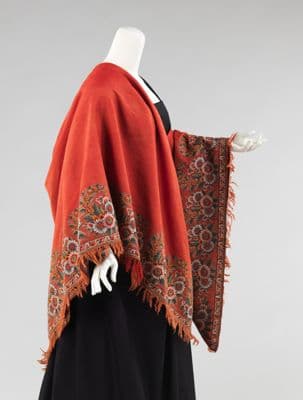
Red Wool Paisley Shawl with Black Cream
Empire / Regency · 1800s · French
Production
handmade
Material
wool
Culture
French
Movement
Orientalism
Influences
Kashmir shawl tradition · Indian paisley motifs
A large rectangular wool shawl displaying the characteristic paisley motif popular during the Empire period. The base fabric is a rich red wool with an intricate woven or printed paisley border featuring teardrop-shaped boteh patterns in black, cream, and green. The shawl shows the typical construction of early 19th century Kashmir-inspired textiles, with a plain center field and elaborate decorative borders along the edges. Twisted fringe trim finishes the perimeter. The substantial weight and size of the textile indicates it was designed to be worn draped over the shoulders as outerwear, complementing the high-waisted Empire silhouette. The complex multi-color paisley work demonstrates the European fascination with Indian textile traditions during this period.
scarf
Connected To
Influences·Indian paisley motifsInfluences·Kashmir shawl traditionMovement·OrientalismMotif·paisley
SHARED60 years · cross-culture
These shawls trace the journey of the Kashmir paisley from Napoleonic luxury to Victorian domesticity, both carrying the teardrop motifs that made European women swoon for "Oriental" exoticism. The earlier red shawl wraps its wearer in bold, saturated color with paisley borders that feel almost militant in their precision, while the later cream version softens the same motifs into something more parlor-appropriate—same DNA, different social temperature.
Text91%
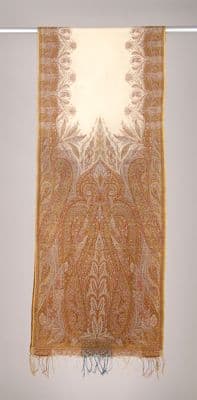
Influences·Indian paisley motifsInfluences·Kashmir shawl traditionTechnique·hand-weavingMotif·
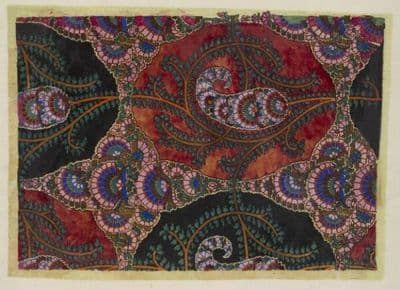
Influences·Kashmir shawl traditionTechnique·hand-weavingMotif·paisley
SHARED50 years · cross-culture
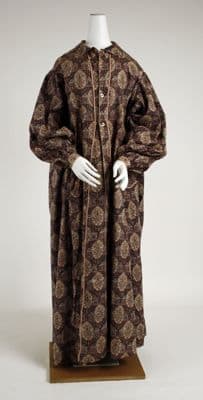
The French Empire shawl and its later Victorian cousin share the same obsession with Kashmir's teardrop paisley, but fifty years of European interpretation have transformed the motif from elegant restraint to horror vacui. Where the earlier red shawl deploys its paisleys with neoclassical discipline—clean borders, breathing room, that refined fringe—the Victorian design has gone completely maximalist, cramming every inch with swirling, interlocking teardrops in a riot of jewel tones.
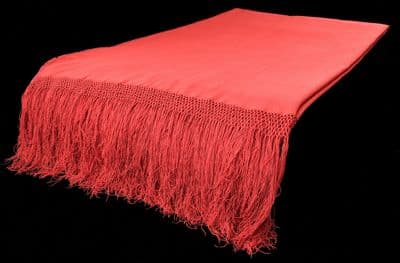
Influences·Kashmir shawl traditionTechnique·hand-weaving
SHARED50 years · cross-culture
These two red shawls trace the journey of the Kashmir shawl from European luxury to American practicality across fifty years of changing taste. The French wool example still carries the dense, botanical intricacy of its Kashmiri prototype—those swirling paisleys crowding every inch of the border like a textile garden—while Susan B. Anthony's silk version has been stripped down to pure geometry: solid coral punctuated only by that decisive fringe.
Echoes Across Time
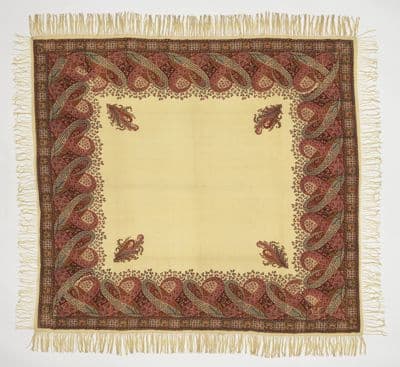
Empire / Regency → Victorian Early / Crinoline · 60yr81%
SHARED
These shawls trace the journey of the Kashmir paisley from Napoleonic luxury to Victorian domesticity, both carrying the teardrop motifs that made European women swoon for "Oriental" exoticism. The earlier red shawl wraps its wearer in bold, saturated color with paisley borders that feel almost militant in their precision, while the later cream version softens the same motifs into something more parlor-appropriate—same DNA, different social temperature.
Influences·Indian paisley motifsInfluences·Kashmir shawl traditionMovement·Orientalism
Pull the Thread→
Follow this garment wherever the graph leads