Victorian Late / Bustle · 1870s-1890s · American
Production
ready-to-wear
Material
cotton paisley
Culture
American
Influences
Kashmir shawl patterns · Indian textile traditions
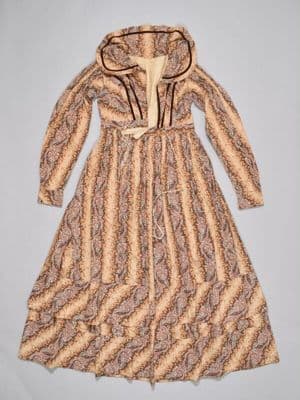
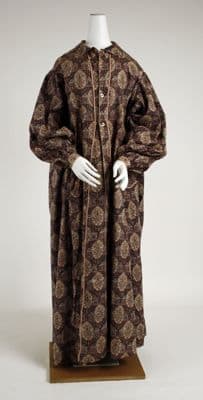
A full-length dressing gown featuring an elaborate paisley pattern in rich earth tones. The garment has a loose, flowing silhouette with wide sleeves that gather at the wrists. The front opening extends the full length with what appears to be button or tie closures. The paisley motifs are densely arranged across the entire surface in varying sizes, creating an intricate all-over design typical of Victorian textile printing. The cotton fabric appears to have a smooth finish that allows the printed pattern to show clearly. The garment reaches to the floor and would have been worn as informal house dress or morning wear, representing the Victorian preference for elaborate patterns and comfortable domestic clothing.
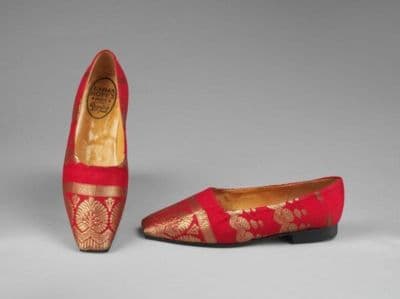
Both pieces carry the ghost of the Raj in their DNA—the Victorian dressing gown wrapped in that unmistakable teardrop paisley that British colonialism lifted from Kashmir shawls, and the 1990s ballet flats embroidered with what looks like stylized paisleys rendered in gold thread against crimson silk.

Both pieces carry the ghost of the Raj in their DNA—the Victorian dressing gown wrapped in that unmistakable teardrop paisley that British colonialism lifted from Kashmir shawls, and the 1990s ballet flats embroidered with what looks like stylized paisleys rendered in gold thread against crimson silk.


Follow this garment wherever the graph leads
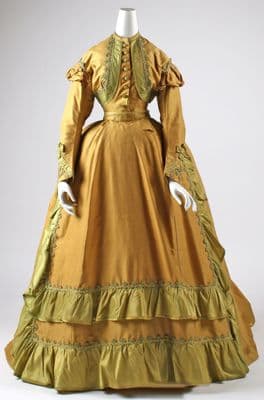
These two garments reveal how Victorian domestic and public spheres borrowed from each other's visual vocabulary across decades. The paisley dressing gown's military-inspired frogging and structured silhouette echo the afternoon dress's elaborate braided trim and fitted bodice, showing how martial details migrated from formal French fashion into American at-home wear.
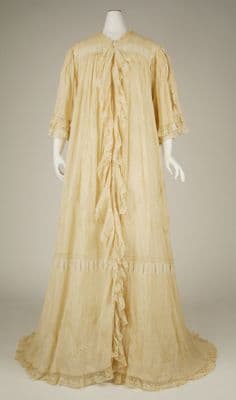
These two robes trace the evolution of intimate luxury from Victorian propriety to Edwardian sensuality. The earlier paisley dressing gown, with its high neckline and deliberate coverage, transforms private moments into formal rituals—even alone, one must be properly dressed. By contrast, the butter-yellow Edwardian negligée whispers rather than announces, its flowing lines and delicate fabric suggesting a new comfort with the body's natural form.
That paisley dressing gown, with its deep burgundy teardrops swimming across brown cotton, speaks the same language of domestic luxury as those golden stockings with their crisp black toe reinforcements. Both pieces inhabit that late Victorian moment when even the most private garments demanded pattern and finish—the gown's intricate all-over print echoing the stockings' deliberate color-blocking at the toe, each detail a small rebellion against the idea that hidden meant plain.
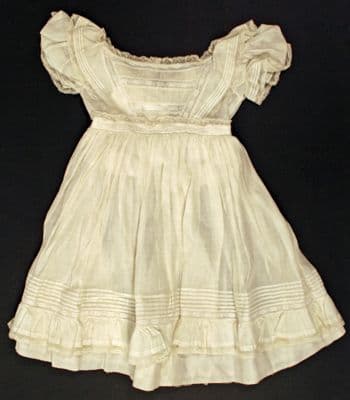
These two garments reveal how the empire waistline's liberating high placement became fashion's great equalizer across age and occasion. The child's cream muslin dress, with its gathered bodice sitting just below the bust and flowing into soft pleats, uses the same anatomical logic as the Victorian woman's paisley dressing gown, where the tie closes at that same elevated point before the fabric cascades freely downward.