SMITHSONIAN
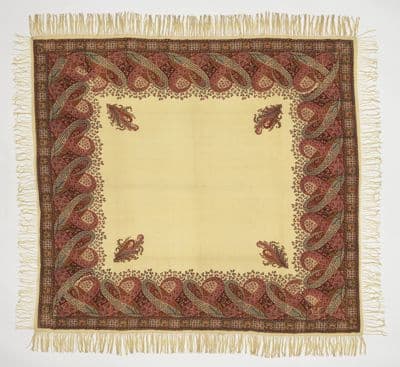
Cream Wool Paisley Shawl with Burgundy Gold Border
Victorian Early / Crinoline · 1860s · English
Production
mass-produced
Material
wool
Culture
English
Movement
Orientalism
Influences
Kashmir shawl tradition · Indian paisley motifs
A square wool shawl featuring an intricate paisley border design in burgundy and gold tones against a cream center field. The paisley motifs are densely woven in a traditional teardrop configuration, creating a continuous decorative band around the perimeter. Small scattered paisley elements appear in the corners of the central cream field. The shawl displays characteristic Victorian-era Kashmir-inspired weaving techniques, with fine twisted fringe finishing all four edges. The complex multi-color warp and weft structure creates depth and richness typical of mid-19th century European interpretations of Indian textile traditions.
scarf
Connected To
Influences·Indian paisley motifsInfluences·Kashmir shawl traditionMovement·OrientalismTechnique·jacquard-weavingTechnique·machine-weavingMotif·paisley
SHARED60 years · cross-culture
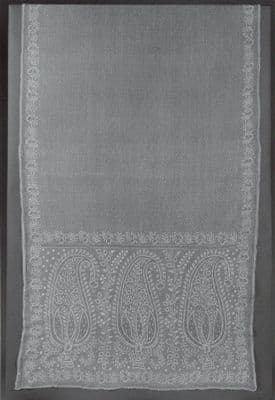
The teardrop paisley that winds along both shawls' borders carries the same genetic code, even as it traveled from the delicate white cotton of Regency drawing rooms to the richer wool and burgundy palette of mid-Victorian taste.
Influences·Indian paisley motifsInfluences·Kashmir shawl traditionMovement·OrientalismMotif·
66%
Influences·Kashmir shawl traditionTechnique·jacquard-weaving
SHARED20 years · cross-culture
These two shawls trace the evolution of Victorian taste from exotic fascination to geometric sophistication. The earlier paisley shawl, with its cream ground and burgundy border dense with traditional boteh motifs, represents the height of mid-century Kashmir fever—when English mills churned out copies of Indian originals for status-conscious women.
Influences·Kashmir shawl tradition
SHARED10 years · cross-culture
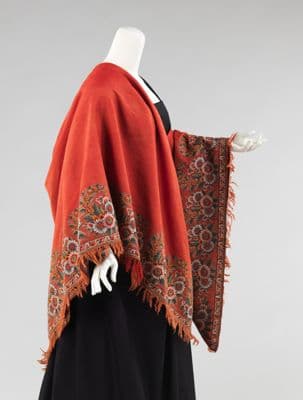
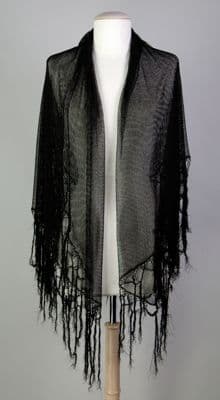
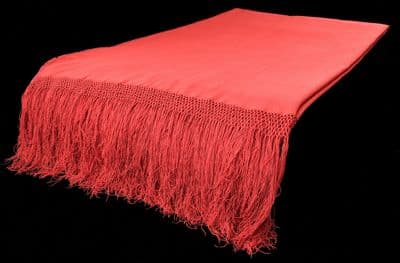
These two shawls trace the global journey of Kashmir's legendary textile craft, but they've landed in completely different worlds. Anthony's crimson silk piece strips the tradition down to its essence—that hypnotic fringe becomes the entire statement, turning what was once ornamental edging into a bold modernist gesture.
Text
Pull the Thread→
Follow this garment wherever the graph leads