Romantic · 1830s · Scottish
Production
artisan-craft
Material
wool
Culture
Scottish
Movement
Paisley shawl industry
Influences
Kashmir shawl tradition · Indian paisley motifs
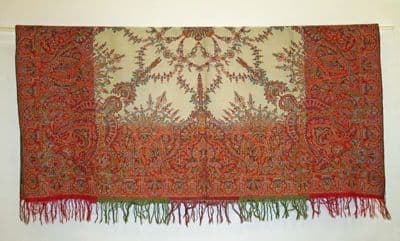
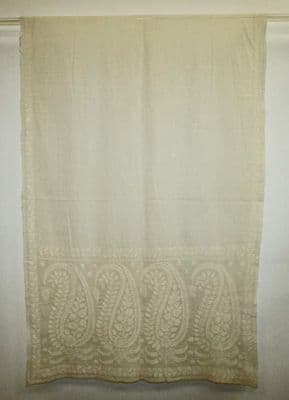
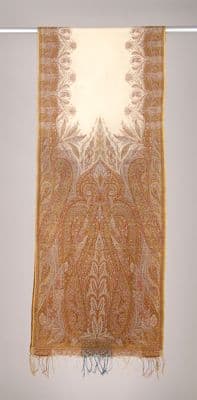
A rectangular wool stole displaying the characteristic paisley patterns of early 19th-century Scottish textile production. The piece features a cream-colored central field bordered by intricate rust and golden brown paisley motifs that create symmetrical designs along the edges. The paisley teardrops are densely packed and elaborately detailed, showing the complex weaving techniques developed in Paisley, Scotland during this period. The stole has finished edges with fringe tassels, indicating careful construction. The overall design demonstrates the Romantic era's fascination with exotic Eastern motifs adapted through European manufacturing, creating the distinctive Kashmir-inspired patterns that became synonymous with Scottish textile production.
Follow this garment wherever the graph leads
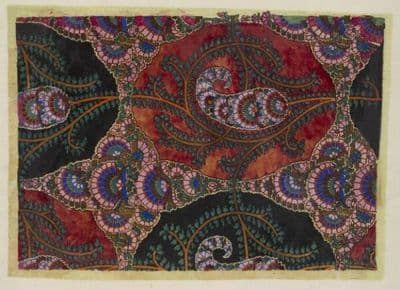
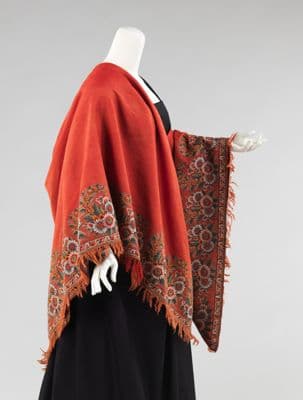
These two shawls reveal how the Victorian obsession with Kashmir paisley evolved from maximalist spectacle to refined restraint. The earlier red shawl drowns in dense, interlocking paisleys that carpet every inch of silk and wool—a textile fever dream where more was always more. The later cream stole pulls back, letting individual paisley motifs breathe against open ground, each teardrop shape now a considered accent rather than part of an all-consuming pattern army.
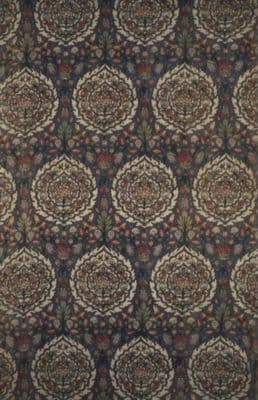
These two shawls trace the evolution of Europe's obsession with the Kashmir paisley, from the cream stole's restrained interpretation of the boteh motif—those teardrop forms climbing symmetrically up the center like botanical specimens pressed in a Victorian album—to the riot of jewel-toned paisleys that swirl across the later piece in burgundy, emerald, and purple.
These two shawls reveal how the Kashmir paisley craze swept through European fashion like wildfire, transforming from exotic luxury to wardrobe staple. The earlier French example shows the motif in its full imperial glory—those dense, swirling paisleys crowding the red wool like a botanical fever dream—while the later Scottish piece has domesticated the same teardrop forms into neat, symmetrical borders framing serene cream wool.
These two scarves trace the long journey of the paisley motif from its origins in Kashmir shawls to mass-market accessibility. The first piece, with its dense, flame-like paisleys rendered in rich browns against cream wool, carries the weight of the original tradition—those intricate boteh patterns that made Kashmir shawls the ultimate luxury good in 19th-century Europe.