THE MET
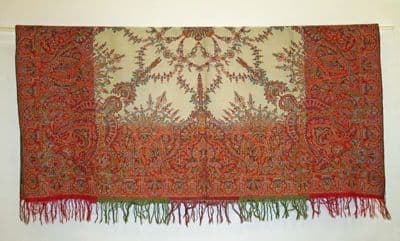
Red Burgundy Paisley Wool Silk Shawl
Victorian Early / Crinoline · 1840s · British
Production
artisan-craft
Material
wool and silk
Culture
British
Movement
Orientalism
Influences
Kashmir shawl tradition · Indian paisley motifs
A rectangular paisley shawl featuring the characteristic teardrop boteh motifs arranged in symmetrical patterns. The central field displays cream-colored ground with intricate paisley designs in burgundy and green, while the border showcases dense red paisley patterns on a darker ground. The shawl demonstrates the complex weaving technique typical of Kashmir-inspired textiles, with fine wool and silk threads creating detailed botanical and geometric infill within each paisley form. Red twisted fringe edges complete the perimeter. The scale and density of the pattern work reflects the Victorian fascination with exotic Eastern textiles, adapted for European fashion sensibilities.
scarf
Connected To
Influences·Indian paisley motifsInfluences·Kashmir shawl traditionMovement·OrientalismTechnique·jacquard-weavingMotif·paisley
SHARED40 years · cross-culture
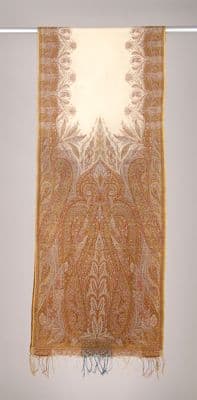
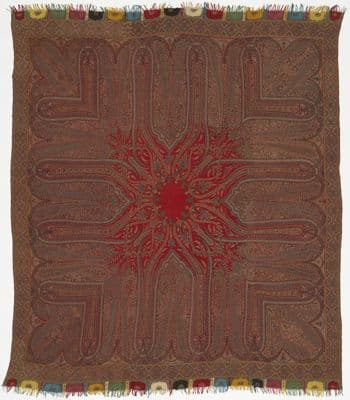
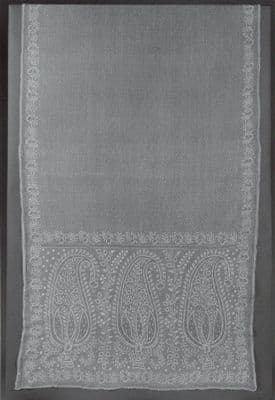
The paisley's journey from Kashmir to European looms plays out in these two shawls like a game of telephone across decades. The earlier white cotton piece whispers its Indian ancestry through delicate, almost tentative paisleys clustered at the border—European mills still learning to speak this foreign visual language.
Text
Influences·Indian paisley motifsInfluences·Kashmir shawl traditionTechnique·hand-weavingTechnique·
Movement·Orientalism
SHARED150 years · cross-culture · cross-category
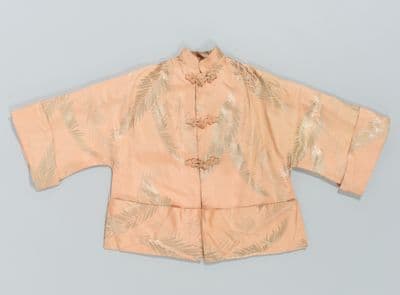
That crimson paisley shawl carries the Victorian obsession with Kashmir's teardrop motifs, its intricate borders speaking the language of British colonial desire for Eastern exoticism. Fast-forward 150 years to this peachy silk jacket with its frog buttons and phoenix brocade, and you're seeing the same Western fascination with Asian aesthetics, just filtered through early-2000s spa culture instead of Empire romanticism.
Text
Technique·hand-weavingTechnique·jacquard-weavingMotif·paisley
SHARED10 years · cross-culture
Echoes Across Time
Victorian Early / Crinoline → Empire / Regency · 40yr83%
SHARED
The paisley's journey from Kashmir to European looms plays out in these two shawls like a game of telephone across decades. The earlier white cotton piece whispers its Indian ancestry through delicate, almost tentative paisleys clustered at the border—European mills still learning to speak this foreign visual language.
Influences·Indian paisley motifsInfluences·Kashmir shawl traditionMovement·Orientalism
Pull the Thread→
Follow this garment wherever the graph leads