V&A
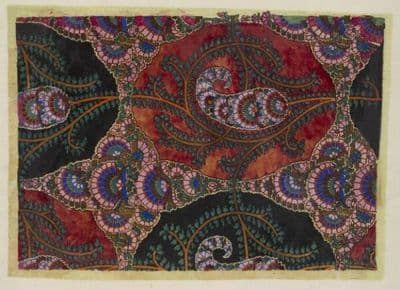
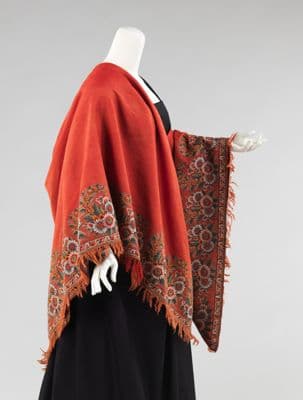
Wool Paisley Shawl Design in Deep Red
Victorian Early / Crinoline · 1850s · British
Production
artisan-craft
Material
wool
Culture
British
Movement
Paisley shawl industry
Influences
Kashmir shawl tradition · Indian boteh motif
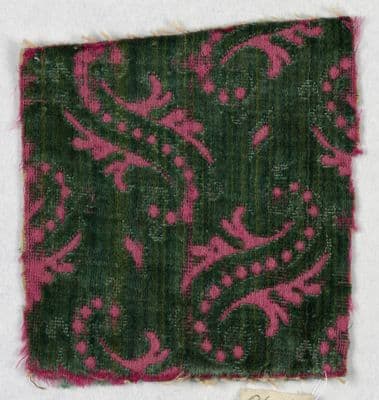
This textile design displays the characteristic teardrop paisley motifs arranged in a complex mirrored pattern typical of mid-19th century Kashmir shawl designs. The boteh forms are filled with intricate floral and geometric details in contrasting colors, creating a rich tapestry effect. The design shows the sophisticated color gradations and fine detailing that made Paisley, Scotland famous for reproducing Kashmir shawl patterns using jacquard looms. The dense patterning covers the entire surface with no background space, demonstrating the Victorian preference for ornate decoration. The curved paisley forms interlock and overlap, creating secondary patterns between the primary motifs.
scarf
Connected To
Influences·Kashmir shawl traditionMovement·Paisley shawl industryTechnique·hand-weavingTechnique·jacquard-weavingMotif·paisley
SHARED20 years · cross-culture
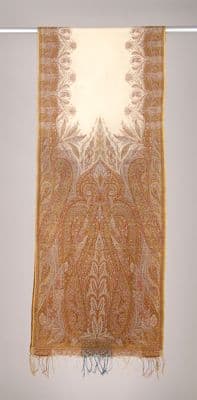
These two shawls trace the evolution of Europe's obsession with the Kashmir paisley, from the cream stole's restrained interpretation of the boteh motif—those teardrop forms climbing symmetrically up the center like botanical specimens pressed in a Victorian album—to the riot of jewel-toned paisleys that swirl across the later piece in burgundy, emerald, and purple.
Text
Influences·Kashmir shawl traditionTechnique·hand-weavingMotif·paisley
SHARED50 years · cross-culture
The French Empire shawl and its later Victorian cousin share the same obsession with Kashmir's teardrop paisley, but fifty years of European interpretation have transformed the motif from elegant restraint to horror vacui. Where the earlier red shawl deploys its paisleys with neoclassical discipline—clean borders, breathing room, that refined fringe—the Victorian design has gone completely maximalist, cramming every inch with swirling, interlocking teardrops in a riot of jewel tones.
Influences·Kashmir shawl traditionTechnique·hand-weavingMotif·paisley
SHARED20 years · cross-culture
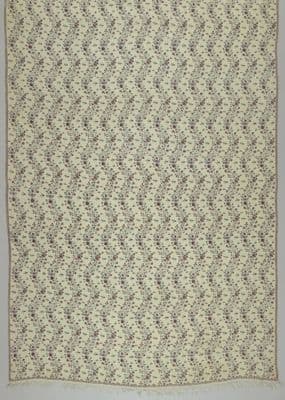
The Victorian shawl's explosive paisley riot—those swirling teardrops packed so densely they seem to pulse against the crimson ground—descends directly from the delicate, orderly paisleys scattered across the earlier Indian example like seeds on cream silk. Where the Indian weaver understood restraint, spacing each burgundy motif to breathe against the neutral field, the British mill cranked up the volume until the pattern became pure visual noise.
Technique·hand-weavingFunction·court-formal
SHARED150 years · cross-culture
Text53%
Echoes Across Time
Empire / Regency → Victorian Early / Crinoline · 50yr68%
SHARED
The French Empire shawl and its later Victorian cousin share the same obsession with Kashmir's teardrop paisley, but fifty years of European interpretation have transformed the motif from elegant restraint to horror vacui. Where the earlier red shawl deploys its paisleys with neoclassical discipline—clean borders, breathing room, that refined fringe—the Victorian design has gone completely maximalist, cramming every inch with swirling, interlocking teardrops in a riot of jewel tones.
Influences·Kashmir shawl traditionTechnique·hand-weavingMotif·paisley
Pull the Thread→
Follow this garment wherever the graph leads