Revolutionary / Directoire · 1790s · American or European
Production
handmade
Material
silk
Culture
American or European
Influences
18th-century court waistcoat · neoclassical simplification
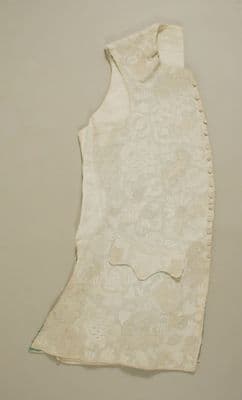
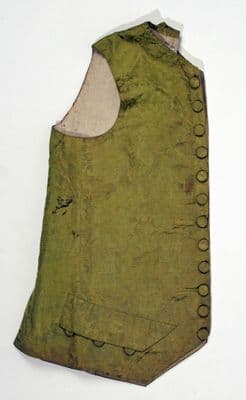
A sleeveless gentleman's waistcoat in olive green silk, displaying the characteristic high-waisted silhouette of the Revolutionary period. The garment features a deep V-neckline and extends to hip length with a straight-cut hem. A row of small covered buttons runs down the center front, numbering approximately fifteen to twenty buttons. The waistcoat shows significant aging and deterioration, with visible tears and fraying throughout the silk fabric. The construction appears to be fully lined, evidenced by the cream-colored lining visible at the armholes and neckline. This style represents the transition from elaborate 18th-century court dress toward the simpler, more democratic fashion ideals of the Revolutionary era.
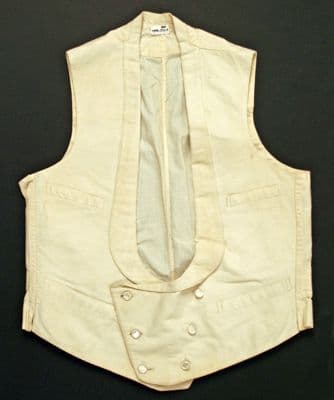
These waistcoats bracket the transformation of masculine elegance from rococo flourish to republican restraint. The cream linen piece, with its delicate silk embroidery and curved hemline, speaks the ornamental language of pre-revolutionary courts—decoration as a mark of leisure and refinement.


These waistcoats bracket the transformation of masculine elegance from rococo flourish to republican restraint. The cream linen piece, with its delicate silk embroidery and curved hemline, speaks the ornamental language of pre-revolutionary courts—decoration as a mark of leisure and refinement.

Follow this garment wherever the graph leads
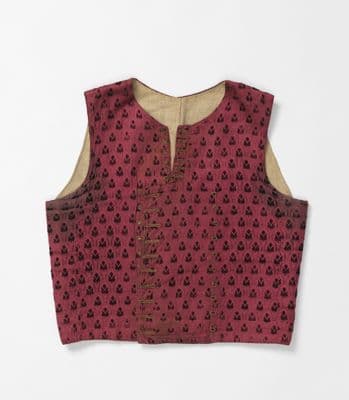
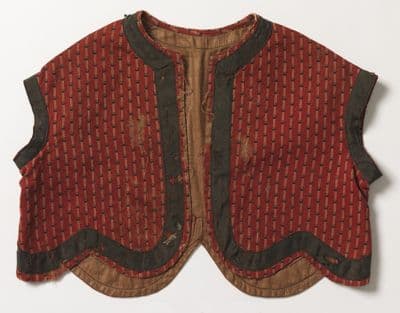
These waistcoats bookend the death of masculine ornament — the burgundy piece still reveling in silk velvet's sensual surface and that tiny geometric print that catches light like scattered jewels, while the olive green survivor looks almost penitent in its plain weave, its only decoration the relentless march of self-covered buttons down the front.
These two waistcoats trace the dramatic shift in masculine ideals across a mere two decades of revolutionary upheaval. The earlier olive green silk version, with its deep scoop and long row of closely-set buttons marching down to the hip, belongs to the world of powdered wigs and courtly display—a garment designed to be seen beneath an open coat, its rich color and luxurious fabric announcing status.
These waistcoats reveal how men's formal wear evolved from Georgian restraint to Victorian flourish across sixty years of social upheaval. The olive silk example, with its clean lines and subtle button march, embodies the neoclassical sobriety that followed the French Revolution—decoration was suspect, simplicity virtuous.

These waistcoats reveal how men's formal wear evolved from Georgian restraint to Victorian flourish across sixty years of social upheaval. The olive silk example, with its clean lines and subtle button march, embodies the neoclassical sobriety that followed the French Revolution—decoration was suspect, simplicity virtuous.