SMITHSONIAN
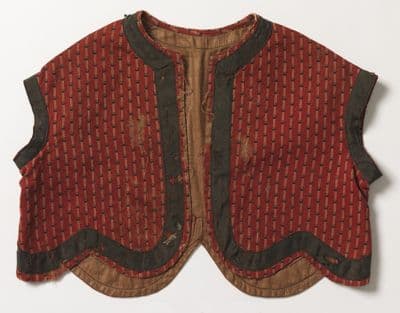
Deep Red Wool Gentleman's Waistcoat with Scalloped Hem
Victorian Early / Crinoline · 1850s · British
Production
handmade
Material
wool
Culture
British
A mid-19th century gentleman's waistcoat featuring a distinctive scalloped hemline with brown wool binding trim. The garment displays an all-over geometric pattern in deep red wool with small repeating motifs creating a textured surface. The front opening shows button closure with brown fabric facing, and the construction demonstrates precise tailoring typical of Victorian menswear. The sleeveless design fits close to the torso, following the period's preference for a trim silhouette. The scalloped lower edge adds decorative interest while the contrasting brown trim provides structural definition along all edges.
vesttight fitv-neckhip length
Connected To
Worn with·coatWorn with·shirt
SHARED90 years · cross-culture
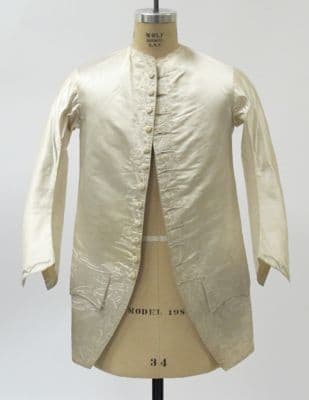
The cream silk waistcoat's pristine, almost monastic simplicity and the red wool vest's jaunty scalloped hem represent two poles of masculine restraint — one achieving elegance through absolute reduction, the other through controlled ornamentation. What bridges them across ninety years is their shared commitment to the fitted torso as the foundation of proper dress, that taut line from shoulder to waist that transforms the male silhouette into something architectural.
Text76%
Image81%
Entity31%
62%
Worn with·coatWorn with·shirt
SHARED100 years
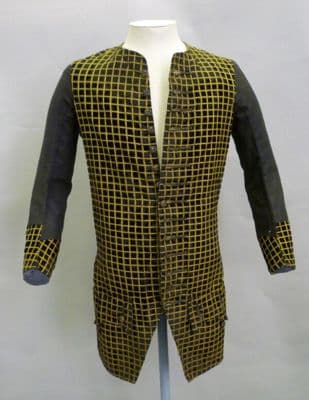
These two waistcoats bookend a century of British menswear, yet both cling to the same aristocratic impulse: pattern as a form of quiet peacocking. The earlier rococo piece flaunts its yellow grid against black velvet like a geometric garden maze, while the Victorian waistcoat opts for a more restrained red-on-red micro-pattern that whispers rather than shouts.
Worn with·coatWorn with·shirt
SHARED60 years · cross-culture
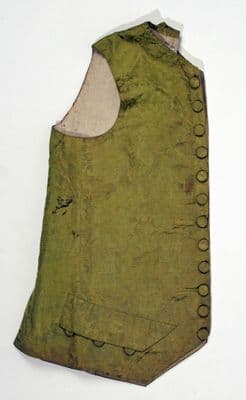
These waistcoats reveal how men's formal wear evolved from Georgian restraint to Victorian flourish across sixty years of social upheaval. The olive silk example, with its clean lines and subtle button march, embodies the neoclassical sobriety that followed the French Revolution—decoration was suspect, simplicity virtuous.
Worn with·coatWorn with·shirt
SHARED90 years · cross-culture
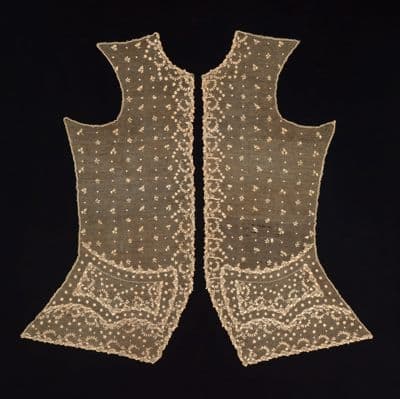
These two waistcoats reveal how men's formal dress evolved from aristocratic ornament to bourgeois restraint across a century of social upheaval. The earlier French piece flaunts its rococo pedigree with delicate floral sprigs scattered like confetti across cream linen—pure court luxury where pattern was power.
Pull the Thread→
Follow this garment wherever the graph leads