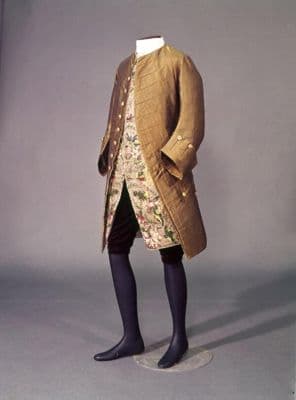
Baroque · 1700s · Spanish
Production
handmade
Material
silk brocade with chenille
Culture
Spanish
Influences
Ottoman kaftan · Asian silk trade textiles
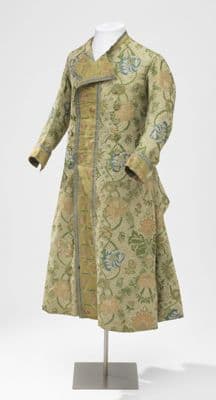
This gentleman's dressing gown features a loose, flowing silhouette that wraps across the body with wide lapels and extends to mid-calf length. The silk brocade displays an elaborate floral pattern with large-scale blooms and foliage rendered in multiple colors against a sage green ground. Chenille threads create textural depth in the botanical motifs. The garment has wide sleeves that taper slightly at the wrists and appears to be constructed without fitted seaming, allowing the rich fabric to drape naturally. Gold braided trim edges the front opening and possibly the cuffs. This represents the 18th-century banyan style worn by gentlemen for informal morning dress or private study.


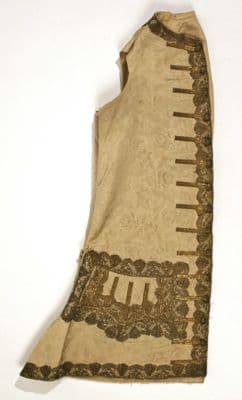
These two garments reveal how 18th-century men's fashion operated on a spectrum of formality, both deploying silk brocade's inherent luxury but for entirely different social performances. The waistcoat's crisp geometric trim and fitted silhouette speak to the public theater of court dress, while the dressing gown's flowing lines and all-over floral pattern suggest the more relaxed intimacy of private chambers—yet both required the same expensive weaving techniques and precious materials.
Follow this garment wherever the graph leads
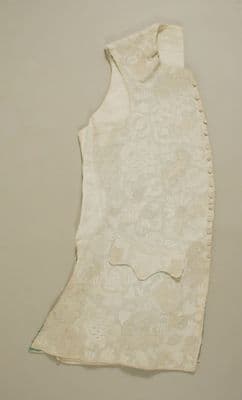
These two garments reveal how 18th-century men's fashion operated on a spectrum of formality, both deploying silk brocade's inherent luxury but for entirely different social performances. The waistcoat's crisp geometric trim and fitted silhouette speak to the public theater of court dress, while the dressing gown's flowing lines and all-over floral pattern suggest the more relaxed intimacy of private chambers—yet both required the same expensive weaving techniques and precious materials.
The cream waistcoat's delicate silk embroidery and the dressing gown's woven brocade both speak the same decorative language of 18th-century masculine luxury, where a gentleman's refinement was measured in florals and foliage rather than stark minimalism. What's striking is how the waistcoat translates the dressing gown's private opulence into public dress—those scattered botanical motifs becoming more restrained, suitable for display beyond the boudoir.
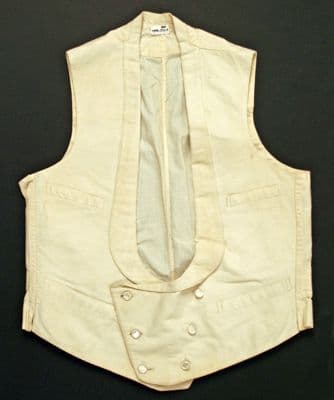
The cream waistcoat's high-buttoned front and the sage brocade banyan represent two poles of 18th-century masculine dressing: one built for public performance, the other for private ease. Both garments speak to the elaborate ritual of men's dress in their respective eras—the waistcoat's precise tailoring and multiple button closure demanding the same careful attention as the banyan's flowing silk sleeves and ornamental frogging.
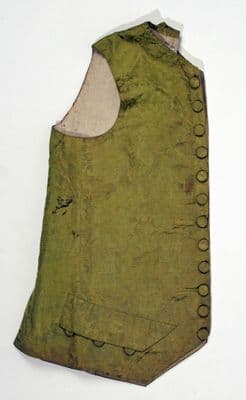
These two pieces trace the elegant decline of masculine silk from Baroque excess to Revolutionary restraint. The Spanish dressing gown's lush brocade—all sinuous florals and metallic chenille threads catching light—speaks to an era when wealthy men wore their status as openly as peacocks, while the American waistcoat's plain olive silk, worn thin and patched, represents the new world's rejection of such displays.


The cream waistcoat's delicate silk embroidery and the dressing gown's woven brocade both speak the same decorative language of 18th-century masculine luxury, where a gentleman's refinement was measured in florals and foliage rather than stark minimalism. What's striking is how the waistcoat translates the dressing gown's private opulence into public dress—those scattered botanical motifs becoming more restrained, suitable for display beyond the boudoir.