Romantic · 1830s · American
Production
handmade
Material
linen
Culture
American
Influences
1830s romantic silhouette · whitework embroidery tradition
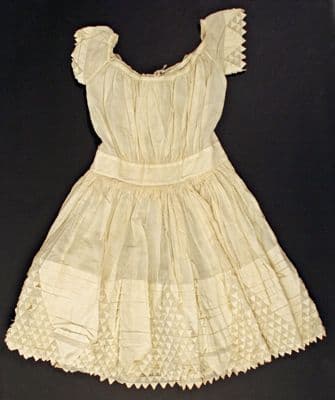
This romantic period dress features a fitted bodice with a wide, off-shoulder neckline edged in delicate scalloped trim. The short, gathered sleeves create soft puffs at the shoulders, characteristic of 1830s feminine silhouettes. The bodice is closely fitted through the natural waist, secured with a narrow sash or belt. The skirt falls in generous gathered folds from the waistline, creating the bell-shaped silhouette favored during the Romantic era. The hemline is decorated with elaborate whitework embroidery featuring geometric and floral motifs, finished with intricate scalloped edging. The lightweight linen fabric and white-on-white embroidered decoration reflect the period's preference for delicate, feminine details and the growing popularity of cotton and linen for day wear.


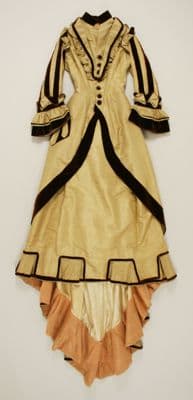
The cream linen dress with its scalloped broderie anglaise trim and the golden silk taffeta bustle gown share the Victorian obsession with decorative edges—one demure in its whitework embroidery, the other bold in its geometric black braid that marches across the polonaise like military frogging.

Follow this garment wherever the graph leads
The cream linen dress with its scalloped broderie anglaise trim and the golden silk taffeta bustle gown share the Victorian obsession with decorative edges—one demure in its whitework embroidery, the other bold in its geometric black braid that marches across the polonaise like military frogging.
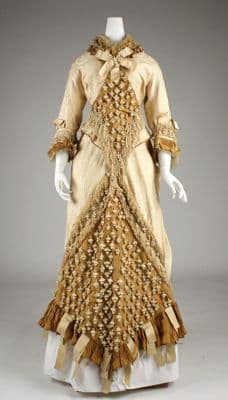
These two cream dresses speak the same language of feminine armor, separated by decades but united in their strategic deployment of texture as seduction. The Belle Époque gown's elaborate golden lattice work cascading down the front transforms the body into a precious object, while the later American dress achieves similar allure through its intricate whitework embroidery and scalloped edges that catch light like the earlier dress's dimensional trim.
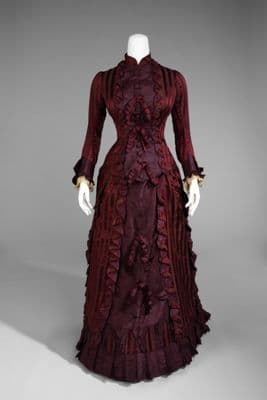
These two dresses reveal the Victorian obsession with controlled volume through completely opposite means. The burgundy bustle gown achieves its drama through architectural engineering—layers of silk taffeta manipulated into cascading ruffles that pool and sweep, creating a silhouette that's all about the back story.
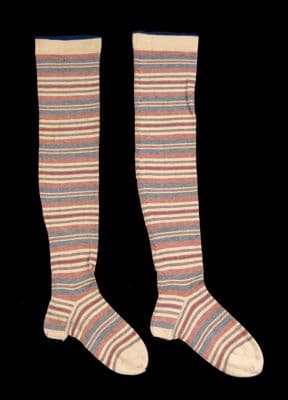
These pieces reveal how Victorian propriety played out in parallel universes of visibility and concealment. The stockings' bold red-white-blue stripes — practically patriotic bunting wrapped around the leg — were meant to flash only in glimpses beneath heavy skirts, while the dress's elaborate whitework embroidery at the hem served as a demure billboard for domestic virtue.

These two cream dresses speak the same language of feminine armor, separated by decades but united in their strategic deployment of texture as seduction. The Belle Époque gown's elaborate golden lattice work cascading down the front transforms the body into a precious object, while the later American dress achieves similar allure through its intricate whitework embroidery and scalloped edges that catch light like the earlier dress's dimensional trim.