Empire / Regency · 1800s-1810s · French
Production
handmade
Material
silk
Culture
French
Movement
Neoclassicism
Influences
neoclassical Greek chiton · Josephine Bonaparte court style
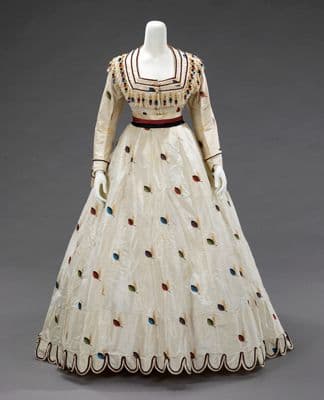
This Empire-style evening gown features a high-waisted silhouette characteristic of the Napoleonic era. The cream silk fabric is decorated with scattered small floral motifs in red and blue throughout the skirt. The bodice displays elaborate geometric trim in gold and dark colors around the square neckline and sleeve edges. Long fitted sleeves extend to the wrists with decorative cuffs. The skirt falls in a straight columnar line from the empire waistline, creating the neoclassical silhouette popular during this period. Dark ribbon or trim defines the high waistline, and scalloped edging adorns the hem, adding textural interest to the garment's clean lines.


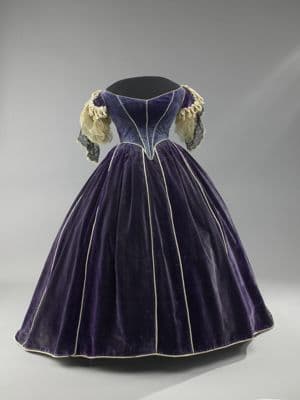
The cream silk gown's scattered jewel-toned motifs and that distinctive scalloped hem with its dark trim speak the same decorative language as Mary Todd Lincoln's purple velvet bodice, where gold braid creates geometric patterns across the neckline and sleeves.

Follow this garment wherever the graph leads
The cream silk gown's scattered jewel-toned motifs and that distinctive scalloped hem with its dark trim speak the same decorative language as Mary Todd Lincoln's purple velvet bodice, where gold braid creates geometric patterns across the neckline and sleeves.
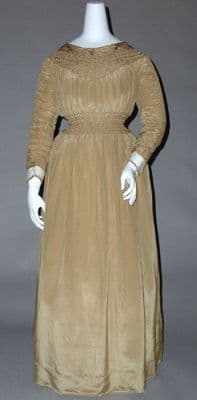
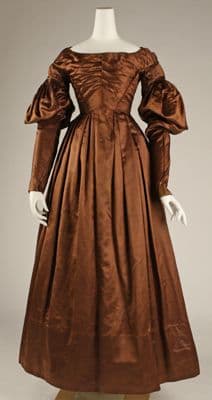
The cream silk gown's scattered jewel-tone embroidered motifs and geometric neckline trim speak the same decorative language as the bronze taffeta's lustrous surface treatment, but where the earlier Empire dress lets ornament float freely across its columnar silhouette, the 1830s gown concentrates all its drama in the sculptural volume of those enormous puffed sleeves.
These two gowns reveal how the empire waistline's flattering promise kept drawing designers back across nearly a century of changing silhouettes. The earlier dress places its high waist exactly where Napoleon's court dictated—just beneath the bust, with scattered polka-dot embroidery dancing across acres of silk like confetti on cream—while the later gown lifts its waistline to a more modest rib-cage height, trading Regency abandon for Edwardian restraint.
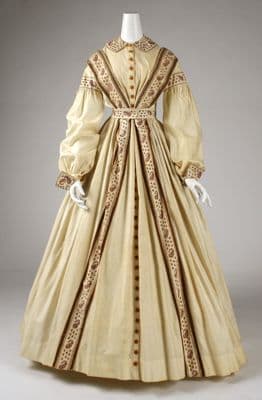
The delicate scatter of tiny embroidered motifs across the Empire gown's white silk finds its echo seventy years later in the Victorian wrapper's elaborate brown trim, but where the earlier dress whispers with restrained neoclassical dots, the American garment shouts with bold geometric braiding that marches down every seam.

These two gowns reveal how the empire waistline's flattering promise kept drawing designers back across nearly a century of changing silhouettes. The earlier dress places its high waist exactly where Napoleon's court dictated—just beneath the bust, with scattered polka-dot embroidery dancing across acres of silk like confetti on cream—while the later gown lifts its waistline to a more modest rib-cage height, trading Regency abandon for Edwardian restraint.